


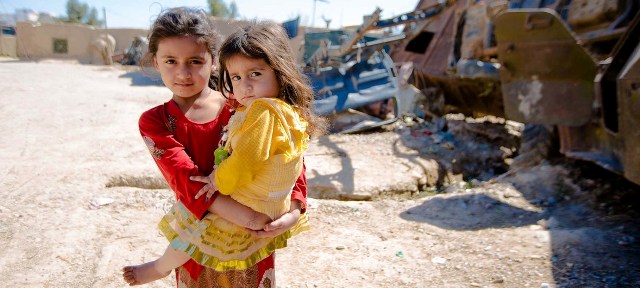
‘No safe way’ into battle-scarred Afghan city of Ghazni to deliver aid as traumatized children search for parents
New York, Aug 18 (IBNS): The city of Ghazni in Afghanistan is still too dangerous for aid workers to reach, after a week of “intense” fighting and reports that traumatized children are turning up at hospitals looking for their parents, UN humanitarian agency, OCHA, said on Friday.
“As of this hour, there is no safe way for civilians or humanitarian workers to enter into Ghazni,” OCHA spokesperson Jens Laerke said, adding that hundreds of civilians are believed to have died since last Friday, in clashes between Taliban fighters and pro-Government forces.
“We estimate that there are some 200-250 civilian casualties, according to the latest unverified numbers,” he said, citing information from the Red Cross in Afghanistan.
Ghazni, in the east of Afghanistan, is one of the country’s largest cities and home to around 270,000 people. It is just the latest place to be affected by an uptick in violence in a country that has experienced more than three decades of protracted conflict, seriously hampering poverty reduction and development.
Although Taliban fighters have been largely driven out of Ghazni city centre after last week’s attacks, house-to-house “clearing operations” are ongoing, according to OCHA.
Amid continuing insecurity, the remaining 25 to 30 aid organizations with a presence in the city “have basically hunkered down”, the agency’s spokesperson told journalists in Geneva.
But aid workers - and food - still cannot reach the city because of the presence of lethal booby traps, or improvised explosive devices (IEDs).In the meantime, fighting has reportedly moved to the outskirts of the city, with Taliban fighters slowly withdrawing towards surrounding villages.
“One of the main reasons for that is that there are IEDs and mines on the way,” Laerke said. “We do have capacity to actually spot and map where these mines are, but we do not have the capacity to remove them. That is the responsibility and within the capacity of the national government to do so.”
Parts of one of the main access roads, Highway 1, have been reportedly “destroyed, contested or contaminated” with IEDs, according to OCHA, which noted in a statement that the weapons had also been placed along the city’s ring road.
The development follows an uptick in violence in Afghanistan, where 80 so-called conflict incidents were recorded daily between July and September, 2017 – the highest number in six years – the UN agency has reported.
Last year also saw 16 district administrative centres attacked and taken over by the Taliban, OCHA said.
Earlier this week, UN Secretary-General António Guterres urged warring parties in Afghanistan to step up efforts towards achieving peace following deadly fighting in Ghazni, after condemning a “heinous” suicide bombing that killed dozens of students – many of them teenagers - at an education centre in the capital, Kabul.
In a bid to assess needs in Ghazni, OCHA has asked local aid workers still in the city to gather information on the number of people requiring help.
Key priorities include restoring the city’s public services. Parts of the water system are functioning again, according to the authorities, and UN Children’s Fund UNICEF, is preparing to dispatch chlorine to flush network clean.
Mobile phone networks are also gradually being restored but electricity in the city is reportedly still largely unavailable, OCHA said in a statement.
“The immediate restoration of electricity, to ensure water supply, is a top priority,” spokesperson Laerke explained.
Other priorities include providing assistance to all those affected by the violence, particularly youngsters.
“We expect that there will be a very big need for psycho-social support amongst the residents including for children,” Laerke said. “There are reports of unaccompanied minors turning up at the hospital, looking for their families.”
According to OCHA, 3.3 million people need humanitarian assistance, and there are growing signs that what was once a low-intensity conflict has now escalated into an escalating war, according to a UN strategic review.
UNICEF/Celeste Hibbert
Support Our Journalism
We cannot do without you.. your contribution supports unbiased journalism
IBNS is not driven by any ism- not wokeism, not racism, not skewed secularism, not hyper right-wing or left liberal ideals, nor by any hardline religious beliefs or hyper nationalism. We want to serve you good old objective news, as they are. We do not judge or preach. We let people decide for themselves. We only try to present factual and well-sourced news.
Support objective journalism for a small contribution.


