PM Modi not in good mood over recent border standoff with China: Donald Trump
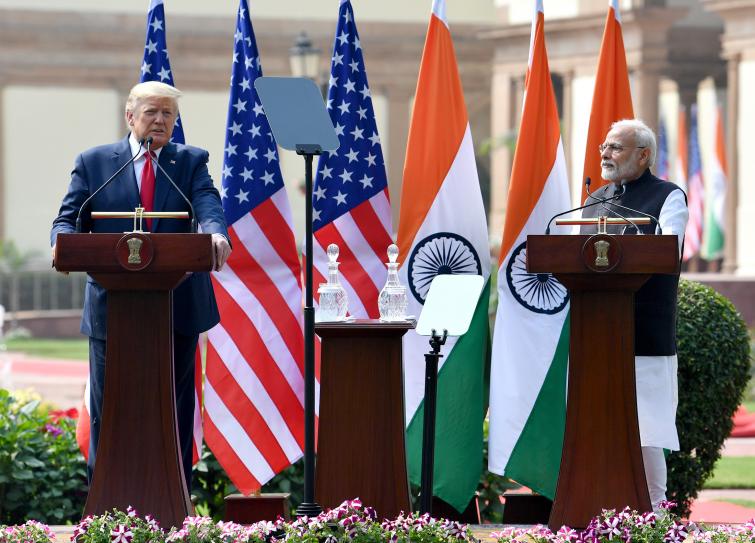
Washington/IBNS: US President Donald Trump on Thursday once again offered to mediate on the border issue between India and China and said he spoke with Narendra Modi about the “big conflict” and he felt the Indian Prime Minister is not in a “good mood” over the recent developments.
Speaking with the reporters in the Oval Office of the White House, Trump said: "Two countries with 1.4 billion people (each). Two countries with very powerful militaries. India is not happy and probably China is not happy."
"I did speak to Prime Minister Modi. He is not in a good mood about what is going on with China," the US President said.
Trump on Wednesday also offered to mediate between India and China over what he described as the 'now raging border dispute' between the two neighbours.
The US president was referring to the recent development along the Line of Actual Control (LAC).
Trump tweeted: "We have informed both India and China that the United States is ready, willing and able to mediate or arbitrate their now raging border dispute. Thank you!"
We have informed both India and China that the United States is ready, willing and able to mediate or arbitrate their now raging border dispute. Thank you!
— Donald J. Trump (@realDonaldTrump) May 27, 2020
There has been rising tension between India and China along the Line of Actual Control (LAC), the de-facto border between the two countries.
Disagreement over the precise location of the LAC, the greater capability created by India in recent years to patrol up to the LAC, and an increasingly assertive Chinese posture have all contributed to the escalation of tensions at the LAC.
Indian and Chinese troops have been involved in as many as four unsavoury incidents in recent weeks alone. Troops from the two countries clashed and came to blows on 5 May near the Pangong Tso lake that falls partly in eastern Ladakh and partly in Tibet.
The face-off between China and India started after Beijing reportedly expressed displeasure about the construction of a road and bridge in the Galwan area by India.
Several troops on both sides were injured. A similar incident occurred on 9 May in Naku La in North Sikkim.
Separately, the Chinese State-run media claimed on 19 May that the People’s Liberation Army (PLA) was “tightening control” by putting up tents in one of the flashpoints in Galwan Valley after it accused India of “unilaterally” changing the status quo by “illegal construction”. A build-up was also reported in Demchok.
Of these incidents, the one at Pangong Tso lake was the most significant as it is in the path of the Chushul approach, one of the main approaches that China can use for an offensive into Indian territory.
Indian assessments show that a major Chinese offensive, if it comes, will flow across both the north and south of the lake. During the 1962 India-China war, this was where China had launched its main offensive. Also, the May 5 incident near Pangong Lake marked at least the third publicly-reported physical confrontation at the same location in the last four years.
The LAC predominantly passes over land, but at Pangong Tso it passes through water. Pangong Tso is a long and narrow lake located at a height of over 4,000 meters in the Himalayas.
The 135 km-long lake sprawls over 604 sq km in the shape of a boomerang and is 6 km wide at its broadest point.
Support Our Journalism
We cannot do without you.. your contribution supports unbiased journalism
IBNS is not driven by any ism- not wokeism, not racism, not skewed secularism, not hyper right-wing or left liberal ideals, nor by any hardline religious beliefs or hyper nationalism. We want to serve you good old objective news, as they are. We do not judge or preach. We let people decide for themselves. We only try to present factual and well-sourced news.