 FCRA
FCRA
‘Myths’ around FCRA Bill? Indian envoy Kwatra cites US, UK laws to counter criticism
New Delhi/IBNS: Indian Ambassador to the United States Vinay Mohan Kwatra has sought to debunk what he described as "myths" surrounding the Foreign Contribution (Regulation) Amendment Bill, 2026, amid stiff resistance from the Opposition and criticism from US Congressman Riley Moore.
The Bill was introduced in the Lok Sabha on March 25, 2026, seeking to amend the Foreign Contribution (Regulation) Act, 2010. Among other provisions, it proposes a framework for the supervision, management and disposal of foreign contributions and assets of organisations that cease to hold an FCRA certificate.
Kwatra counters concerns over FCRA Bill
In a lengthy post on X, Kwatra addressed what he described as misunderstandings in sections of the media and civil society regarding India's FCRA Amendment Bill and Rules, 2026.
He presented the proposed changes as an evolution of India's regulatory framework aimed at strengthening transparency, accountability and national security in the regulation of foreign funds.
US Congressman Riley Moore raises concerns
The proposed legislation has also drawn criticism from US Congressman Riley Moore.
Moore described the proposed FCRA changes as a "clear attack" on Christians and alleged that they could allow the Indian government to take control of churches and religious charities. He also warned that the legislation could have implications for India-US bilateral ties.
The Indian government has rejected the criticism. The Ministry of External Affairs said the legislation was an internal matter for India and pointed out that several countries, including the United States, have laws regulating foreign funding.
Kwatra counters claims of India being uniquely restrictive
Kwatra's post sought to address concerns surrounding the proposed FCRA amendments, particularly claims that India has an unusually restrictive approach towards foreign funding.
He argued that several countries have introduced laws and mechanisms to regulate foreign funding and influence, especially in areas involving politics, non-governmental organisations and public opinion.
Cites foreign laws on regulating overseas influence
Kwatra cited several international examples to support his argument.
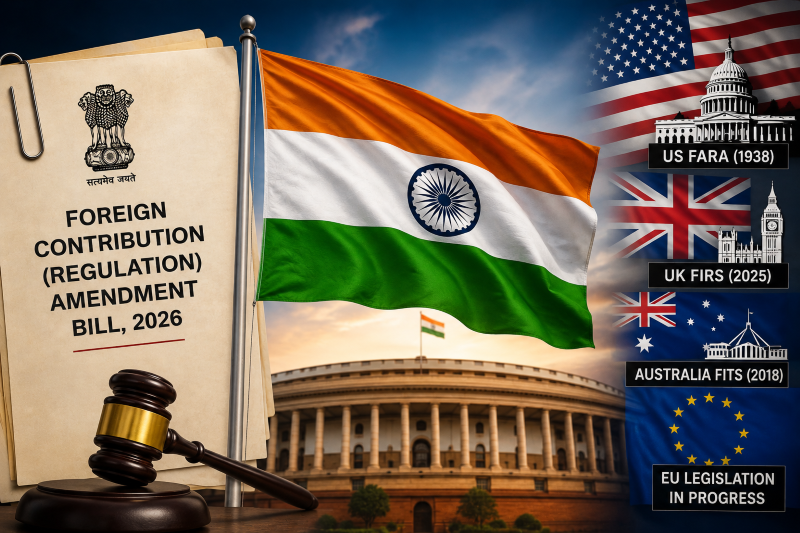
These included the United States' Foreign Agents Registration Act (FARA), enacted in 1938, which requires certain individuals and organisations acting on behalf of foreign principals to register with the government.
He also referred to the US Foreign Account Tax Compliance Act (FATCA), introduced in 2010, and Australia's Foreign Influence Transparency Scheme, which came into effect in 2018.
Canada's 2024 legislation addressing foreign interference and its proposed transparency registry were also cited.
Kwatra further pointed to the UK's Foreign Influence Registration Scheme (FIRS), which became effective in July 2025, as well as ongoing legislative efforts within the European Union.
FCRA changes framed as transparency measures
By highlighting these international frameworks, Kwatra sought to position India's proposed FCRA changes as being broadly aligned with global efforts to increase transparency around foreign influence.
The post argued that such regulations are intended to bring greater scrutiny to foreign funding and influence involving political activities, NGOs and public opinion.
The proposed FCRA amendments have drawn opposition from political parties and civil society groups, who have raised concerns over their potential impact on organisations receiving foreign contributions.
Support Our Journalism
We cannot do without you.. your contribution supports unbiased journalism
IBNS is not driven by any ism- not wokeism, not racism, not skewed secularism, not hyper right-wing or left liberal ideals, nor by any hardline religious beliefs or hyper nationalism. We want to serve you good old objective news, as they are. We do not judge or preach. We let people decide for themselves. We only try to present factual and well-sourced news.
Support objective journalism for a small contribution.