 SIR
SIR
Kolkata: Mamata calls off dharna against SIR after five days, says ‘fight for justice’ will continue
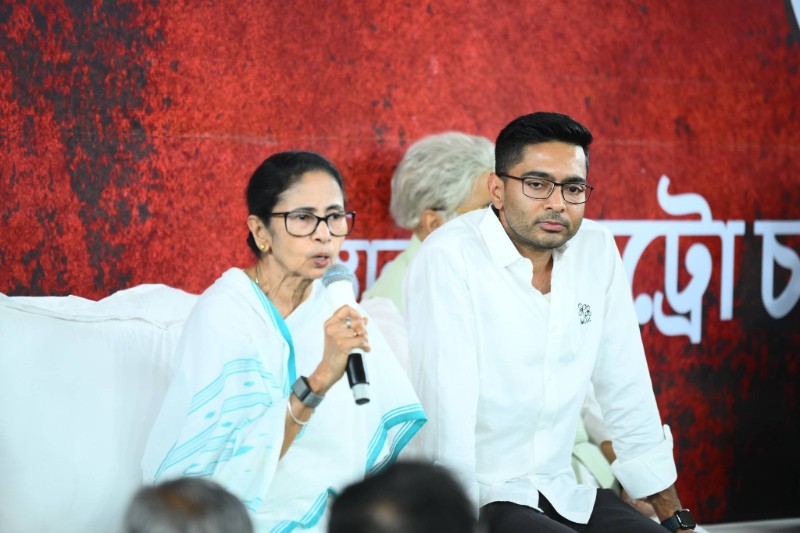
Kolkata/IBNS: West Bengal Chief Minister Mamata Banerjee on Tuesday called off her sit-in protest in Kolkata's downtown Esplanade area after five days, bringing an end to a high-profile demonstration over the SIR issue.
Before formally withdrawing the protest, Banerjee consulted Trinamool Congress national general secretary Abhishek Banerjee and other party leaders present at the site.
While announcing the decision, the Chief Minister made it clear that the agitation may have concluded at the protest venue, but the broader struggle for justice would continue through other means.
She also invoked past political movements such as the Singur and Nandigram agitations, suggesting that political history often repeats itself and that such struggles have long-term consequences.
Mamata Banerjee revisited memories of the Singur movement, one of the most significant protests in West Bengal’s recent political history.
She reminded supporters that she had once observed a 26-day hunger strike in Singur to protest the acquisition of farmland from local cultivators.
The Chief Minister remarked that she could have continued the Esplanade protest for much longer if necessary.
“If required, I can sit here for fifty days as well,” she said while addressing supporters.
Drawing a parallel with the Singur agitation, Banerjee also criticised a senior Election Commission official without directly naming him.
She alleged that the same individual who had once been involved in forcibly acquiring farmers’ land in Singur had now been appointed to a significant position by the Election Commission of India.
Banerjee said the protest was not only about electoral issues but also about challenging what she described as administrative injustice.
After five continuous days of demonstrations at the busy Esplanade intersection, Mamata Banerjee acknowledged the inconvenience caused to local residents and businesses.
She apologised to shopkeepers, traders and pedestrians who had been affected by the protest activities, particularly due to the continuous use of loudspeakers and public address systems.
The TMC supremo announced the withdrawal of the protest after accepting a suggestion from Abhishek Banerjee.
Banerjee claimed the movement had achieved its immediate objective by opening the doors for further legal and political action.
After calling off the dharna, the Bengal Chief Minister said that she would meet outgoing Governor of the state, C. V. Ananda Bose.
The meeting is scheduled to take place at ‘Soujanya’, a residence located in Alipore where Bose is currently staying after completing his gubernatorial tenure.
The Chief Minister described the meeting as a courtesy call, though the timing has attracted attention given the political context surrounding the protest.
Earlier on Tuesday, the Supreme Court of India said it would not tolerate any questioning of the integrity of judicial officers tasked with handling West Bengal’s Special Intensive Revision (SIR) of electoral rolls, while hearing pleas related to the voter revision drive.
Responding to submissions flagging the pendency of claims before judicial officers, a bench led by Chief Justice of India Surya Kant and Justice Joymalya Bagchi observed that the application appeared premature.
However, the court directed Sujoy Paul, Chief Justice of the Calcutta High Court, to constitute an appellate bench of former High Court Chief Justices and former High Court judges to hear appeals against deletions in the final voter list.
The number of judges in the special bench will be decided by Justice Paul, the court said.
Meanwhile, the full bench of the Election Commission of India, led by Chief Election Commissioner Gyanesh Kumar on Tuesday left Kolkata after holding multiple review meetings ahead of the West Bengal assembly polls.
Support Our Journalism
We cannot do without you.. your contribution supports unbiased journalism
IBNS is not driven by any ism- not wokeism, not racism, not skewed secularism, not hyper right-wing or left liberal ideals, nor by any hardline religious beliefs or hyper nationalism. We want to serve you good old objective news, as they are. We do not judge or preach. We let people decide for themselves. We only try to present factual and well-sourced news.
Support objective journalism for a small contribution.