 ISRO
ISRO
ISRO successfully tests IAD technology to land future missions in Mars, Venus
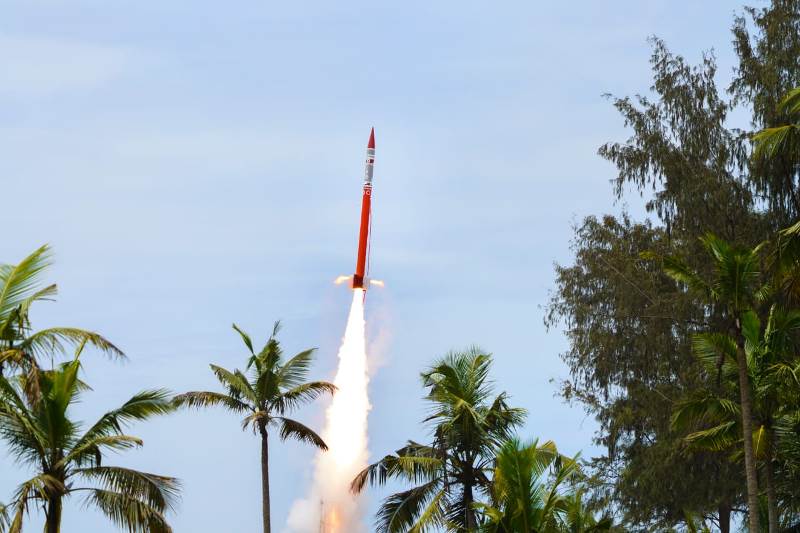
The Indian Space Research Organisation (ISRO) has successfully tested the Inflatable Aerodynamic Decelerator (IAD) which will facilitate landing payloads on Mars or Venus in the future.
The IAD is being developed for aerodynamically decelerating an object descending through the atmosphere, ISRO said.
The IAD was initially folded and kept inside the payload bay of the rocket.
At around 84 km altitude, the IAD was inflated and it descended through the atmosphere with the payload part of sounding rocket.
In a brief, ISRO revealed that the IAD is kept stowed in the nosecone of the single-stage Rohini-300 (RH300MKIl) Sounding Rocket. "At 100 seconds after take-off, the nosecone is separated, followed by the inflation of IAD at 110 s, using compressed Nitrogen stored in a gas bottle. The payload is separated from the motor at 200 seconds after take-off, by using an FLSC separation system," ISRO said.
(2/2) Flown in stowed condition, IAD inflated at ~84 km altitude & descended through the atmosphere. IAD enables various space applications like recovery of spent stages of rockets, landing payloads on Mars/Venus, and making space habitats for humans.
— ISRO (@isro) September 3, 2022
The IAD has huge potential in variety of space applications like recovery of spent stages of rocket, for landing payloads on to Mars or Venus and in making space habitat for human space flight missions.
Rohini sounding rockets are routinely used for flight demonstration of new technologies being developed by ISRO as well as by scientists from India and abroad.
In Saturday's flight, along with IAD new elements like a micro video imaging system that captured the bloom and flight of IAD, a miniature software-defined radio telemetry transmitter, a MEMS-based acoustic sensor and a host of new methodologies were flight tested successfully.
These will be inducted later to the major missions. Sounding rockets offer an exciting platform for experimentation in the upper atmosphere.
"This demonstration opens a gateway for cost-effective spent stage recovery using the Inflatable Aerodynamics Decelerator technology and this IAD technology can also be used in ISRO's future missions to Venus and Mars," said S Somanath, Chairman ISRO, Secretary DOS who witnessed the launch.
The launch was also witnessed by senior dignitaries of ISRO including Dr S Unnikrishnan Nair, Director, VSSC and Dr V Narayanan, Director, LPSC.
Support Our Journalism
We cannot do without you.. your contribution supports unbiased journalism
IBNS is not driven by any ism- not wokeism, not racism, not skewed secularism, not hyper right-wing or left liberal ideals, nor by any hardline religious beliefs or hyper nationalism. We want to serve you good old objective news, as they are. We do not judge or preach. We let people decide for themselves. We only try to present factual and well-sourced news.
Support objective journalism for a small contribution.