 Rajnath Singh
Information war can threaten our political stability: Rajnath Singh
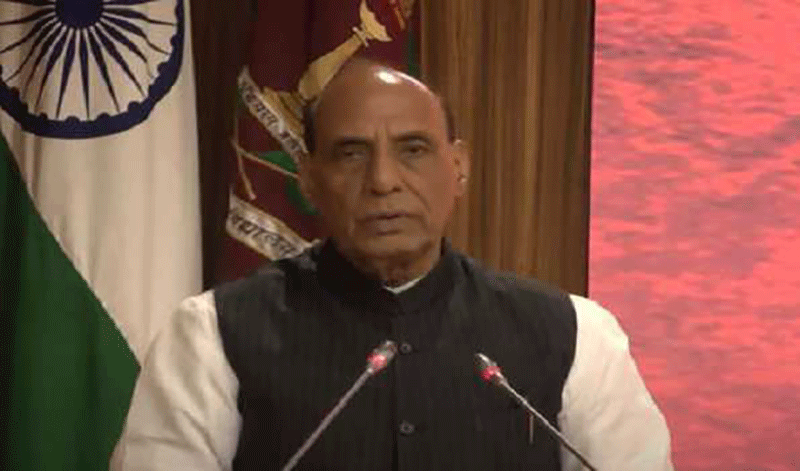
New Delhi/UNI: The information war has the potential to threaten our political stability, Defence Minister Rajnath Singh said on Thursday drawing attention to emerging security threats.
Speaking at the Convocation Ceremony in the National Defence College here, he said that the vulnerability of critical infrastructure to cyber-attacks has become a big concern.
"The gap between internal and external security is getting narrower. New dimensions of security threats are emerging, that are becoming increasingly difficult to classify.
"We are facing such security threats, which fall into the category of non-kinetic and non-contact warfare. Cyber warfare and information warfare are such security threats," the minister said.
"Critical infrastructure like power generation and distribution is increasingly becoming more complex and reliant on networks of connected devices.
"The energy sector is one of the main targets of cyber-attacks against critical infrastructure, but it is not the only one. Transport, public sector services, telecommunications and critical manufacturing industries are also vulnerable," he said.
Speaking on dangers of information warfare in times of increasing use of social media the Minister said that it can threaten political stability.
"There is no account of how much fake news and hate material is likely to be brought into society through social media platforms.
"The organised use of social media and other online content generation platforms is being used for engineering the opinion or perspective of the masses," he said.
Singh said that the deployment of information war was most evident in the on-going conflict between Russia and Ukraine.
Rajnath Singh said that in order to counter these grave security challenges the comity of civilised nations need to work collectively.
"If security becomes a truly collective enterprise, then we can think of creating a global order which is beneficial to all of us.
"The global community has been working towards it and there exist a lot of multilateral organisations, working in the field of security like UNSC," the Defence Minister said.
The Minister said that the Russia-Ukraine conflict has fuelled an energy crisis in the world.
"In Europe, oil and gas supply has been dwindling. India has also been affected as the Russia-Ukraine war led to a disruption in international energy supply, making the energy import much more expensive," he said.
Singh said that Russia and Ukraine together export nearly a third of the world's wheat and barley. But this conflict had prevented grain from leaving the 'breadbasket of the world' and led to food crisis in various African and Asian countries," the Minister added.
Singh said that India believes in a multi-aligned policy which is realized through diverse engagements with multiple stakeholders, so that views and concerns of all can be discussed and addressed for a prosperous future for all.
"We should strive to create a win-win situation for all. We should not be guided by narrow self-interest which is not beneficial in the long-run, but by enlightened self-interest which is sustainable and resilient to shocks," he said.
Singh also said that a strong and prosperous India would not be built at the cost of others.
Rather, India is here to help other nations realise their full potential, he added.
Support Our Journalism
We cannot do without you.. your contribution supports unbiased journalism
IBNS is not driven by any ism- not wokeism, not racism, not skewed secularism, not hyper right-wing or left liberal ideals, nor by any hardline religious beliefs or hyper nationalism. We want to serve you good old objective news, as they are. We do not judge or preach. We let people decide for themselves. We only try to present factual and well-sourced news.
Support objective journalism for a small contribution.