 Semiconductors
India's semiconductor ambition: Modi visits TEL Miyagi's factory in Sendai with Ishiba
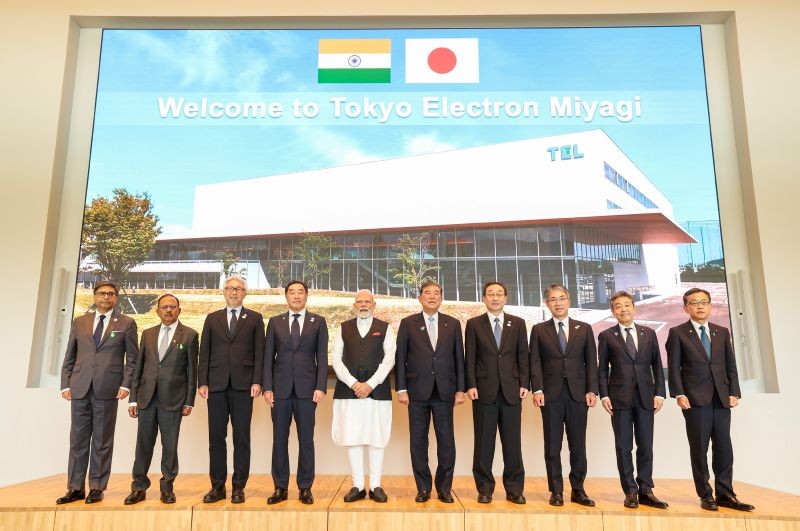
Prime Minister Narendra Modi, accompanied by his Japanese counterpart, Shigeru Ishiba, on Saturday travelled to Sendai in Miyagi Prefecture, where they visited a leading semiconductor facility.
"In Sendai, the two leaders visited Tokyo Electron Miyagi Ltd (TEL Miyagi), a leading Japanese company in the semiconductor sector," read the government statement.
Prime Minister Modi was briefed about TEL’s role in the global semiconductor value chain, its advanced manufacturing capabilities and its ongoing and planned collaborations with India.
The factory visit gave the leaders a practical understanding of the opportunities that exist between the two countries to forge collaboration in the field of semiconductor supply chain, fabrication and testing.
The visit to Sendai highlighted the complementarity between India’s growing semiconductor manufacturing ecosystem and Japan’s strengths in advanced semiconductor equipment and technology.
Both sides reaffirmed their commitment to deepening cooperation in this sector, building on the Memorandum of Cooperation on the Japan–India Semiconductor Supply Chain Partnership as well as ongoing partnerships under the India–Japan Industrial Competitiveness Partnership and Economic Security Dialogue.
This joint visit by Prime Minister Modi and Prime Minister Ishiba also underscored the shared vision of India and Japan to develop robust, resilient and trusted semiconductor supply chains.
Prime Minister Modi conveyed his appreciation to Prime Minister Ishiba for joining him in this visit and reaffirmed India’s readiness to work closely with Japan in this strategic domain.
Prime Minister Ishiba hosted a lunch in honour of Prime Minister Modi in Sendai. The Governor of Miyagi Prefecture along with other dignitaries were present on the occasion.
India's semiconductor route
A report released by an Indian bank has shown India's semiconductor market, valued at USD 34.3 billion in 2023, is expected to triple to USD 100.2 billion by 2032.
The global semiconductor industry is on track for strong expansion, with its market size projected to touch USD 1 trillion by 2030, growing at a compound annual growth rate of nearly 10 per cent between 2023 and 2030, ANI news agency reported quoting the Union Bank of India Research report.
The Ministry of Electronics and Information Technology (MeitY) announced recently that it has approved 23 semiconductor design projects under its Design Linked Incentive (DLI) scheme.
The move strengthens support for domestic start-ups and MSMEs working on chip designs for applications such as surveillance systems and smart energy meters, Business Standard reported.
The ministry also confirmed that 72 firms have been granted access to industry-grade Electronic Design Automation (EDA) tools, enabling them to fast-track their chip design processes.
India’s wider semiconductor mission
The approvals come as part of the Centre’s broader semiconductor strategy, which covers both design and large-scale production.
Earlier this month, the Union Cabinet approved four additional chip manufacturing proposals under the India Semiconductor Mission (ISM).
Two of these facilities will be set up in Odisha, while Andhra Pradesh and Punjab will host one each.
In total, 10 semiconductor projects worth ₹1.6 trillion are now in the pipeline across six states, projected to create thousands of direct and indirect jobs.
The latest approved projects include proposals from SiCSem, Continental Device India Pvt. Ltd (CDIL), 3D Glass Solutions Inc., and Advanced System in Package (ASIP) Technologies.
Together, they represent investments of around ₹4,600 crore and are expected to generate over 2,000 direct jobs, along with significant ancillary employment.
Support Our Journalism
We cannot do without you.. your contribution supports unbiased journalism
IBNS is not driven by any ism- not wokeism, not racism, not skewed secularism, not hyper right-wing or left liberal ideals, nor by any hardline religious beliefs or hyper nationalism. We want to serve you good old objective news, as they are. We do not judge or preach. We let people decide for themselves. We only try to present factual and well-sourced news.
Support objective journalism for a small contribution.