India is keen to suppress international terrorism: Vice President
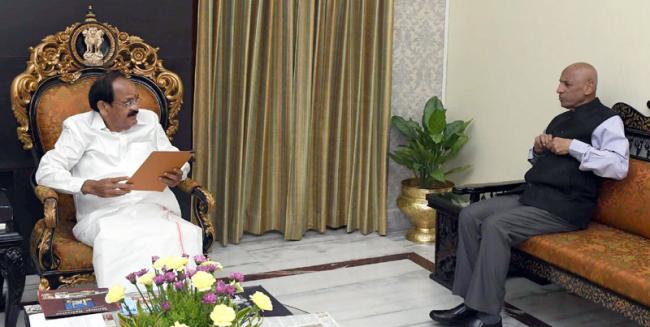
He was addressing the 78th Session of International Institute of Law at NALSAR University of Law in Hyderabad, on Sunday.
The Governor of Telangana, E S L Narasimhan, the Acting Chief Justice of High Court of Judicature at Hyderabad, Justice Ramesh Ranganathan, the Deputy Chief Minister of Telangana, Mohammad Mahmood Ali, the Minister for Law, Government of Telangana, A. Indrakaran Reddy and other dignitaries were present on the occasion.
The Vice President said that several conventions resulted from the efforts exerted under the auspices of the United Nations. SAARC convention on the suppression of international terrorism as well as the Indian proposal to conclude a comprehensive convention on suppression of international terrorism is now under consideration of the UN, he added.
The Vice President said that India has put considerable effort in fighting international terrorism and terrorism is the biggest danger the world is facing today, for which there is no justification.
He further said that India today is the one of the largest economies and has a young and educated work force.
It represents a mature Parliamentary democracy with a highly independent judiciary and fourth estate, he added.
The Vice President said that holding the 78th Session of International Institute of Law in India will not only create greater awareness on the importance of international law but will also inspire young lawyers and students to specialize in this subject.
The concept of the rule of law has been practiced in India from times immemorial, he pointed.
He further said that the Sanskrit word Dharma broadly deals with righteousness, duty and law and it is derived from the root word denoting uphold, sustain, nourish and support.
He also stated that the two great epics Ramayana and Mahabharatha epitomize how Dharma, embodied through righteousness and justice, forms the basis for triumph of good over evil and for protecting mankind.
“Dharmo Rakshati Rakshitah”, the Sanskrit sloka in Manu Smriti aptly sums up the basic Indian philosophy - the law will protect and defend those who protect and defend it, he added.
The Vice President said that India attaches huge importance to the implementation of international statutes and the rule of law and is a firm believer in promotion of peace and justice globally.
He further said that India was among the countries which played a key role in the development of some of the important global conventions and also those formulated by the United Nations like the Law of Sea Convention.
India has also made a significant contribution to the formation of the Asian-African Legal Consultative Organization to promote international law, he added.
The Vice President said that India is a signatory to many important international treaties, protocols and agreements include Convention on Biological Weapons, Convention on Chemical Weapons, Chicago Convention on International Aviation, Convention on Rights of Child, International Convention on Doping in Sport, Genocide Convention, the Statute of Hague Conference on Private International Law, Kyoto Protocol, Montreal Protocol, Nuclear Terrorism Convention and International Convention on Elimination of all Forms of Racial Discrimination.
The Vice President said that India played an active role in the UN and in the codification and progressive development of international law during the 60s.
He further said that India’s foreign policy is based on sovereign equality of States, non-intervention in the internal affairs of other States and peaceful settlement of disputes in accordance with principles articulated in Article 33 of the United Nations.
Our country attaches high importance to bilateral negotiations in settling its differences and disputes with other nations on the basis of international law, justice and equity, he added.
Support Our Journalism
We cannot do without you.. your contribution supports unbiased journalism
IBNS is not driven by any ism- not wokeism, not racism, not skewed secularism, not hyper right-wing or left liberal ideals, nor by any hardline religious beliefs or hyper nationalism. We want to serve you good old objective news, as they are. We do not judge or preach. We let people decide for themselves. We only try to present factual and well-sourced news.
Support objective journalism for a small contribution.