'India-EU trade deal nears finish line': European Commission Prez at Davos, calls it ‘mother of all deals’
European Commission President Ursula von der Leyen on Tuesday signalled that negotiations for a long-awaited free trade agreement between India and the European Union have entered a decisive phase, saying the two sides are “on the cusp of a historic trade agreement” that could reshape global commerce and supply chains.
Speaking at the World Economic Forum in Davos, von der Leyen framed the proposed deal as part of Europe’s broader push for “fair trade over tariffs, partnership over isolation, and sustainability over exploitation.”
She said the EU was working to de-risk its economy and diversify supply chains by strengthening ties with major global growth centres, with India playing a central role in that strategy.
“And right after Davos, the next weekend, I will travel to India. There is still work to do, but we are on the cusp of a historic trade agreement,” she said, adding that the pact has been described by some as the “mother of all deals.”
According to von der Leyen, the agreement would create a combined market of around two billion people and account for nearly a quarter of global GDP, offering European businesses a significant first-mover advantage in one of the world’s fastest-growing economies.
Her remarks mark the clearest public indication so far that both New Delhi and Brussels are pushing to conclude the long-pending negotiations, which have spanned several years but gained renewed momentum amid shifting geopolitical and economic realities.
The EU, like other major economies, is seeking to reduce over-reliance on a narrow set of suppliers and build resilient supply chains, particularly in strategic sectors such as clean technology, digital infrastructure, pharmaceuticals and critical raw materials.
Placing India at the heart of Europe’s Indo-Pacific outlook, von der Leyen described the region as one of the “economic powerhouses of this century.”
“Europe wants to do business with the growth centres of today and the economic powerhouses of this century, from Latin America to the Indo-Pacific and far beyond,” she said, adding that Europe “will always choose the world, and the world is ready to choose Europe.”
Her comments come ahead of a high-profile visit to India later this month.
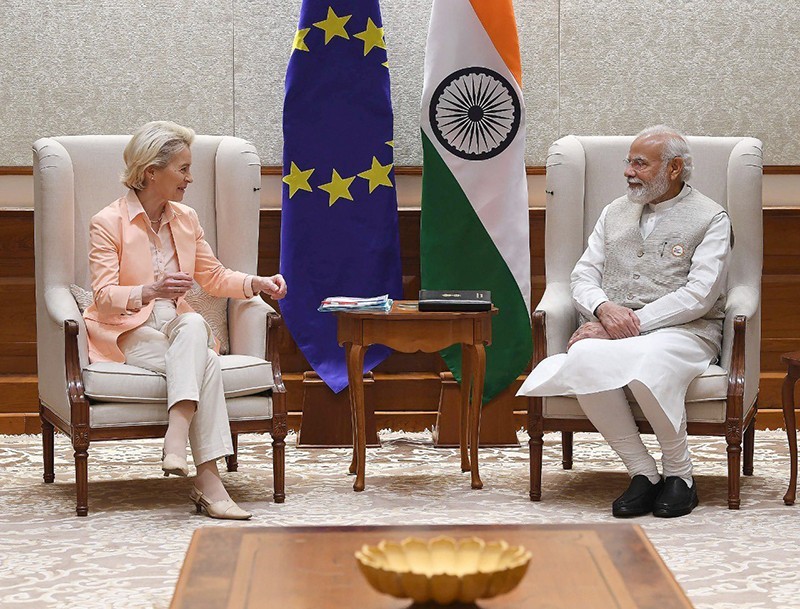
According to India’s Ministry of External Affairs, von der Leyen and European Council President Antonio Costa will be on a State Visit to India from January 25 to 27 at the invitation of Prime Minister Narendra Modi. The two leaders will be the Chief Guests at India’s 77th Republic Day celebrations.
During the visit, they will also co-chair the 16th India-EU Summit with Prime Minister Modi on January 27, hold meetings with India’s President, and participate in both restricted and delegation-level talks.
An India-EU Business Forum is also expected to be held on the sidelines of the summit.
India and the EU have been strategic partners since 2004, but ties have deepened in recent years, particularly after the visit of the EU College of Commissioners to India in February 2025.
If concluded, the proposed agreement would rank among the largest and most comprehensive trade deals globally, covering not only goods but also services, investment, digital trade, sustainability and regulatory cooperation.
While negotiators on both sides acknowledge that complex issues remain, von der Leyen’s remarks at Davos suggest strong political will to bridge the remaining gaps.
With the New Delhi summit just days away, expectations are rising that India and the EU could move significantly closer to sealing what Brussels has already termed a “historic” and potentially game-changing trade pact.
Support Our Journalism
We cannot do without you.. your contribution supports unbiased journalism
IBNS is not driven by any ism- not wokeism, not racism, not skewed secularism, not hyper right-wing or left liberal ideals, nor by any hardline religious beliefs or hyper nationalism. We want to serve you good old objective news, as they are. We do not judge or preach. We let people decide for themselves. We only try to present factual and well-sourced news.
Support objective journalism for a small contribution.