'How can we involve Chief Justice with any executive appointment?' Jagdeep Dhankar's big remark on separation of powers
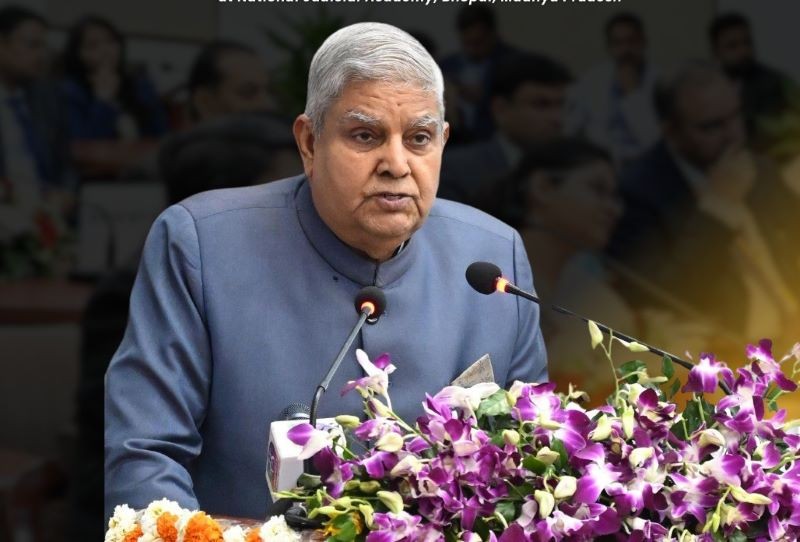
Bhopal/IBNS: Vice President Jagdeep Dhankhar Friday said the country's Chief Justice should not be involved in making any executive appointment in a democracy like India.
"How can in a country like ours or any democracy, by statutory prescription, the Chief Justice of India participate in the selection of the CBI director? Can there be any legal rationale for it?" Dhankhar said.
"I can appreciate that the Statutory prescription took shape because the executive of the day has yielded to a judicial verdict. But the time has come to revisit. This surely does not merge with democracy. How can we involve the Chief Justice of India with any executive appointment?" he added.
His statement comes ahead of a meeting to select the next Chief Election Commissioner.
The selection would be a first since the Chief Election Commissioner And Other Election Commissioners (Appointment, Conditions of Service And Term of Office) Act, 2023, was passed.
The act came after a verdict by the Supreme Court in March 2023 which directed for a three-member panel comprising the Prime Minister, the Leader of the Opposition and the Chief Justice (CJI) to operate till Parliament enacted a law.
The new law, however, excluded the CJI from the panel. Detractors say the new law leads to excessive interference of the executive in the appointments and is detrimental to the independence of the poll panel.
Chief Election Commissioner (CEC) Rajiv Kumar will retire on February 18 and the selection committee for appointing his successor is expected to meet possibly on Monday.
The committee, comprising Prime Minister Narendra Modi, Law Minister Arjun Ram Meghwal, and Leader of the Opposition in the Lok Sabha Rahul Gandhi, will deliberate on the appointment a day before the Supreme Court hears petitions against the new law.
While speaking at the National Judicial Academy in Bhopal, Dhankar said: "Executive governance by judicial decree is a Constitutional paradox, that the largest democracy on the planet cannot afford any longer. When institutions forget their bounds, democracy is remembered by the wounds this forgetfulness imparts."
He said that these institutions should operate within defined constitutional bounds while "maintaining cooperative dialogue, keeping national interest in mind".
"Executive governance reflecting the will of the people is constitutionally sanctified. Accountability is enforceable when executive roles are performed by an elected government. Governments are accountable to the legislature. And periodically accountable to the electorate. But if executive governance is arrogated or outsourced, the enforceability of accountability will not be there," he added.
Recalling his stint as Parliamentary Affairs Minister in 1990, Dhankhar said the Supreme Court then had eight judges.
"More often than not, all the eight judges sat together (on a bench hearing a case)....When the strength of the Supreme Court was eight judges, under Article 145(3), there was a stipulation that the interpretation of the Constitution will be by a bench of five judges or more," he said.
The essence and spirit with the founding fathers had in mind in under Article 145 (3) about the Constitution must be respected. If I analyse arithmetically, they were very sure, interpretation will be by majority of judges, because the strength then was eight. That five stands as… pic.twitter.com/iMv6LoD03b
— Vice-President of India (@VPIndia) February 14, 2025
"Please note, when this strength was eight, it (size of constitutional bench) was five. And the Constitution allows the highest court of the land to interpret the Constitution," he added.
But under the guise of interpretation, there can be no "arrogation of authority", and the essence and spirit which the founding fathers had in mind under Article 145(3) must be respected, the vice president further said.
Article 145(3) of the Constitution of India states that at least five judges are required to sit on a case involving the interpretation of the Constitution.
Support Our Journalism
We cannot do without you.. your contribution supports unbiased journalism
IBNS is not driven by any ism- not wokeism, not racism, not skewed secularism, not hyper right-wing or left liberal ideals, nor by any hardline religious beliefs or hyper nationalism. We want to serve you good old objective news, as they are. We do not judge or preach. We let people decide for themselves. We only try to present factual and well-sourced news.
Support objective journalism for a small contribution.