 Counter-Insurgency
Endgame for Maoists in India? Ganesh Uikey killed in Odisha encounter, Devuji only top leader left
Bhubaneswar/IBNS: India’s long-running Maoist insurgency appears to be entering its terminal phase following the killing of Ganesh Uikey, a senior Central Committee member and the top leader of the outlawed movement in Odisha.
Security officials say Uikey’s death has left Devuji, an ageing ideological figure, as the only remaining leader of comparable rank—underscoring how sharply the once-formidable insurgent hierarchy has thinned.
Uikey was eliminated in a major counterinsurgency operation in Kandhamal district, delivering another decisive blow to Maoist leadership after the earlier neutralisation of notorious commander Madvi Hidma.
A significant milestone towards Naxal-free Bharat.
— गृहमंत्री कार्यालय, HMO India (@HMOIndia) December 25, 2025
In a major operation in Kandhmal, Odisha, 6 Naxalites, including Central Committee Member Ganesh Uike, have been neutralized so far.
With this major breakthrough, Odisha stands at the threshold of becoming completely free from…
With successive eliminations at the apex, security agencies increasingly view the movement as a shadow of its former self, struggling to retain relevance, territory, or organisational coherence.
Intelligence-led operation in Kandhamal
According to officials, the operation was launched following precise intelligence gathered by the Special Intelligence Wing.
Multiple forces were deployed across the Chakapad police station area of Kandhamal and adjoining forest tracts of Ganjam district under the Rambha range.
A total of 23 teams participated, including 20 units from the Special Operations Group, two from the Central Reserve Police Force and one from the Border Security Force.
Odisha anti-naxal encounter:
— Defence Sphere (@DefenceSphere) December 25, 2025
4 naxals were eliminated, total 6 in the last 2 days. Rs 1.2-crore bounty Maoist Ganesh Uike also gunned down. pic.twitter.com/zCFKYBpBh8
The scale of deployment reflected the importance attached to targeting what remained of the Maoist command structure in eastern India.
Early on December 25, security personnel encountered armed cadres in dense forest zones spanning the Chakapad and Belghar police station limits.
Several rounds of gunfire were exchanged before the Maoists retreated deeper into the terrain.
Bodies, weapons recovered after encounter
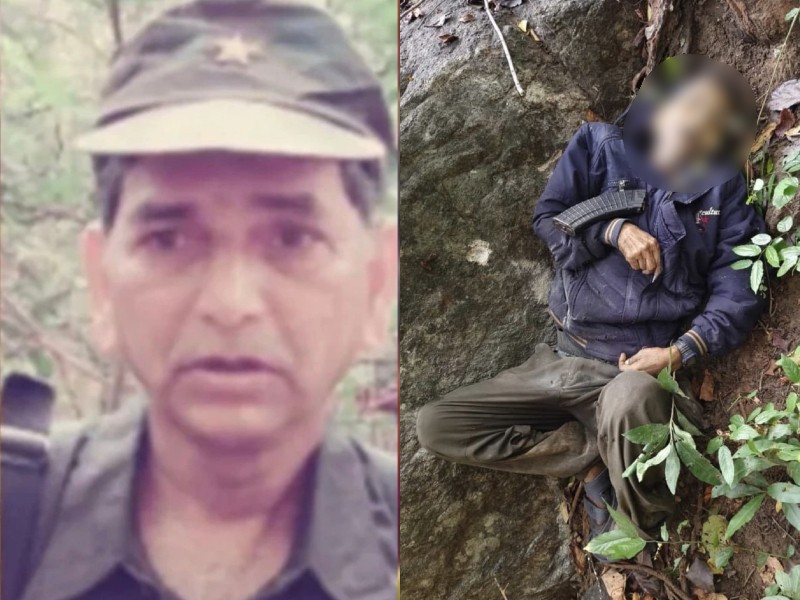
Subsequent search operations led to the recovery of four bodies dressed in Maoist uniforms—two men and two women—along with two INSAS rifles and a .303 rifle.
One of the deceased was confirmed to be Ganesh Uikey.
The identities of the remaining three cadres are still being verified, and combing operations are continuing to ensure no armed groups escaped the cordon.
Officials described the recovery as a significant intelligence and morale boost, noting that senior Maoist leaders have become increasingly difficult to locate as their networks fragment and shrink.
Ganesh Uikey’s role in the insurgency
Unlike frontline guerrilla commanders, Ganesh Uikey functioned primarily as the administrative pillar of the Maoist apparatus in Odisha and neighbouring regions.
He rose through the ranks as an organiser, overseeing logistics, finances and internal communication during the insurgency’s peak years.
His role was crucial in holding together zonal committees and ensuring coordination between scattered units.
However, prolonged years underground took a heavy toll.
#WATCH | Bhubaneswar: Top Maoist leader Ganesh Uike, carrying Rs1.1 crore bounty, killed in encounter
— ANI (@ANI) December 25, 2025
Odisha DGP Yogesh Bahadur Khurania says, "A major anti-Naxal joint operation is underway on the border of Ganjam district. This morning, the Odisha Police and security forces… pic.twitter.com/nF8uNwLktb
Security sources say Uikey suffered from chronic ailments, struggled to walk without assistance, and relied on a tightly controlled security detail that included women cadres trained to blend into local populations.
As his health deteriorated, the movement’s ability to plan and execute coordinated operations weakened.
What was once a structured regional network gradually splintered into isolated cells, dependent on sporadic guidance from a leader increasingly constrained by age and illness.
Devuji emerges as last top leader
With Uikey’s death, attention has shifted to Devuji, whom intelligence agencies describe as an ideological veteran and former key figure in the Maoists’ military wing.
Now believed to be the only remaining leader at the top tier, Devuji represents the last link to the insurgency’s earlier strategic core.
Like Uikey, Devuji is said to be elderly and in poor health, operating with a dwindling circle of loyalists.
Officials assess that his current role is largely symbolic, focused more on preserving ideological continuity than commanding active operations.
Security agencies believe the absence of younger, capable leaders has left the Maoist movement unable to regenerate or adapt, accelerating its decline.
A collapsing hierarchy
The latest operation highlights the cumulative impact of sustained counterinsurgency efforts across Maoist-affected regions.
The elimination of senior leaders, erosion of territorial control, disruption of funding channels, and steady loss of local support have all contributed to weakening the insurgency’s foundations.
Officials note that the Maoists’ appeal among local communities has diminished sharply, further isolating remaining cadres and limiting their ability to recruit or hide effectively.
Endgame in sight
Security forces say operations will continue until the remaining armed elements are neutralised and affected areas fully stabilised.
While pockets of resistance may persist, the death of Ganesh Uikey and the isolation of Devuji are seen as markers of a movement nearing exhaustion.
Once regarded as one of India’s most enduring internal security challenges, Maoist extremism now appears reduced to its final embers—kept alive more by ideology and memory than by operational strength.
Support Our Journalism
We cannot do without you.. your contribution supports unbiased journalism
IBNS is not driven by any ism- not wokeism, not racism, not skewed secularism, not hyper right-wing or left liberal ideals, nor by any hardline religious beliefs or hyper nationalism. We want to serve you good old objective news, as they are. We do not judge or preach. We let people decide for themselves. We only try to present factual and well-sourced news.
Support objective journalism for a small contribution.