 Platform Economy
Digital financial inclusion could unlock greater participation of women in India’s platform economy: ILO-NCAER
New Delhi/IBNS: India’s rapidly expanding platform economy could offer women greater flexibility and access to employment, but limited financial inclusion, inadequate digital literacy, safety concerns and restrictive social norms continue to hold back their participation, according to an ILO-NCAER policy brief released on Monday.
The brief, titled “Advancing Women’s Digital Financial Inclusion in the Platform Economy”, argues that financial access needs to extend beyond basic banking if women are to participate more fully in platform-based work.
According to the brief, women need access to a wider range of financial services throughout their platform-work journey, including start-up capital, short-term credit, insurance, savings and tools for financial planning.
The findings come as India’s platform workforce is projected to expand sharply in the coming years.
NITI Aayog estimates that the number of platform workers could increase from 12 million in 2024-25 to 23.5 million by 2029-30.
Cashflow-based lending could help women access credit
One of the key areas highlighted by the ILO-NCAER brief is the use of cashflow-based lending to improve women’s access to formal credit.
Women are less likely than men to own land or property that can be offered as traditional collateral.
This can make it difficult for them to obtain loans, particularly when they are trying to start or expand a platform-based livelihood.
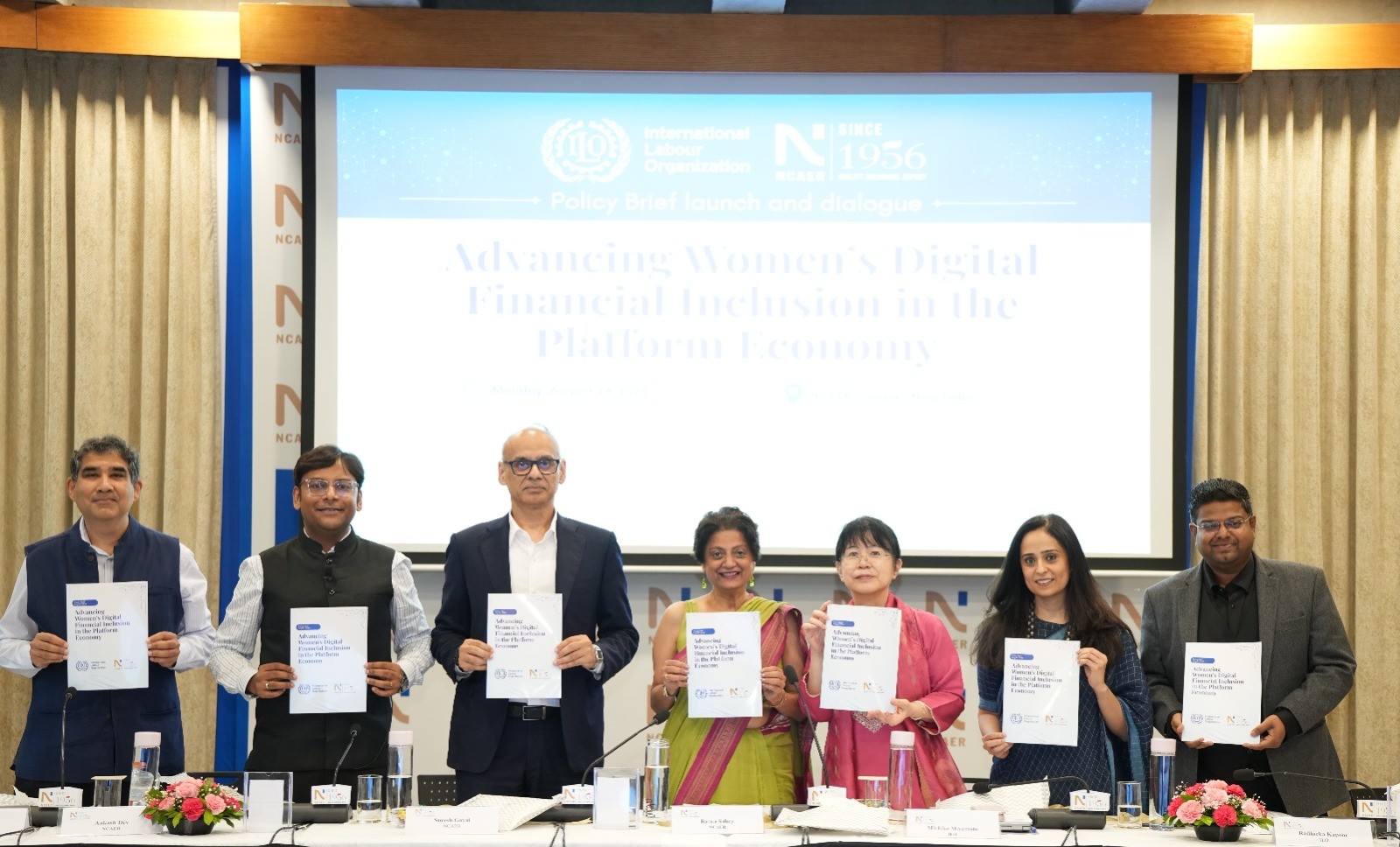 Release of ILO-NCAER Policy Brief on Women in India's Platform Economy. Photo: PR Team
The brief points to digital records of platform payments as a potential alternative source of financial information.
Regular payment records could provide lenders with verifiable evidence of a worker’s income and repayment capacity, allowing financial institutions to assess borrowers based on cash flows rather than solely on assets.
This could become particularly relevant for women working through digital platforms, where payment histories can generate a documented record of earnings.
Digital footprints could become a financial asset
The policy brief identified two ways in which women’s digital footprints could be used to improve financial access.
One involves using India’s Digital Public Infrastructure, including the Account Aggregator framework, to make financial information portable and allow individuals to share relevant financial data securely with authorised institutions.
The second involves partnerships between digital platforms and financial institutions, enabling workers to access services such as loans, savings products and insurance directly through platform applications.
The approach could connect women’s participation in the digital economy with formal financial services, particularly where conventional credit assessments do not adequately capture irregular or non-traditional sources of income.
NCAER director general Suresh Goyal highlighted the importance of women having independent financial resources while speaking at the roundtable held to mark the release of the policy brief.
“A woman’s best protection is a little money of her own, and access to credit and mobility are important conditions for women to have better employment opportunities. The platform economy has given that opportunity,” Goyal said.
ILO calls for stronger income security and resilience
The International Labour Organization also stressed the need to ensure that digital financial inclusion translates into greater economic security for women rather than simply expanding access to digital financial products.
ILO country director Michiko Miyamoto said, “Digital financial inclusion must enable women to build income security, resilience, and sustainable livelihoods.”
The emphasis on income security is particularly relevant to platform workers, whose earnings can fluctuate and who may not have the same employment protections or financial stability associated with conventional salaried jobs.
Access to savings and insurance could therefore play an important role in helping workers manage periods of reduced income and unexpected expenses.
Linking financial DPI with e-Shram
ILO Senior Specialist Radhicka Kapoor said the integration of financial Digital Public Infrastructure with e-Shram records could potentially widen access to formal financial services.
The e-Shram platform maintains records of unorganised workers, including people engaged in various forms of informal employment.
Linking relevant financial and employment information could help lenders and other service providers develop a clearer picture of workers’ economic activity.
However, the brief stressed that such systems would require safeguards against algorithmic bias.
The concern is particularly significant for women because automated systems used for credit assessment or financial decision-making could reproduce existing inequalities if they rely on incomplete or biased data.
Device ownership remains a basic digital barrier
Financial inclusion also depends on access to the devices required to use digital services.
The ILO-NCAER brief identified device ownership as a continuing barrier for women, noting that women’s access to digital technology is often mediated through family members.
Limited control over smartphones or other digital devices can restrict women’s ability to independently access financial services, manage earnings, make transactions or use platform applications.
Digital literacy is another constraint.
Access to a device alone does not necessarily translate into meaningful participation in the digital economy, particularly when users lack the skills or confidence required to navigate financial and employment platforms.
Safety concerns and social norms can further restrict women’s ability to participate in platform-based work, even where flexible employment opportunities are available.
India’s platform workforce expected to nearly double
The policy discussion comes as the platform economy is expected to become a much larger part of India’s labour market.
NITI Aayog estimates that India’s platform workforce will rise from 12 million in 2024-25 to 23.5 million by 2029-30.
The projected growth could expand opportunities for women, particularly in forms of work that offer greater flexibility around location and working hours.
However, the ILO-NCAER brief makes clear that flexibility alone does not remove the financial and structural barriers that affect women’s participation.
Access to credit, insurance, savings and financial planning can influence whether women can enter platform work, sustain their participation and withstand fluctuations in income.
Regulation and consumer protection remain central
Ratna Sahay, director of NCAER’s Centre for Gender and Macroeconomy, said women’s digital records could significantly alter their access to financial services if appropriate regulatory safeguards are in place.
“Digital footprint in platform economies can be a game-changer for women to access credit, underpinned by regulation that encourages innovation while ensuring consumer protection and financial stability,” Sahay said.
The ILO-NCAER brief consequently places digital financial inclusion at the intersection of employment, technology and access to finance.
As India’s platform workforce expands, the ability of women to benefit from that growth will depend not only on the availability of flexible work but also on whether digital financial systems can give them independent access to credit, savings, insurance and other services while protecting their data and financial interests.
Support Our Journalism
We cannot do without you.. your contribution supports unbiased journalism
IBNS is not driven by any ism- not wokeism, not racism, not skewed secularism, not hyper right-wing or left liberal ideals, nor by any hardline religious beliefs or hyper nationalism. We want to serve you good old objective news, as they are. We do not judge or preach. We let people decide for themselves. We only try to present factual and well-sourced news.
Support objective journalism for a small contribution.