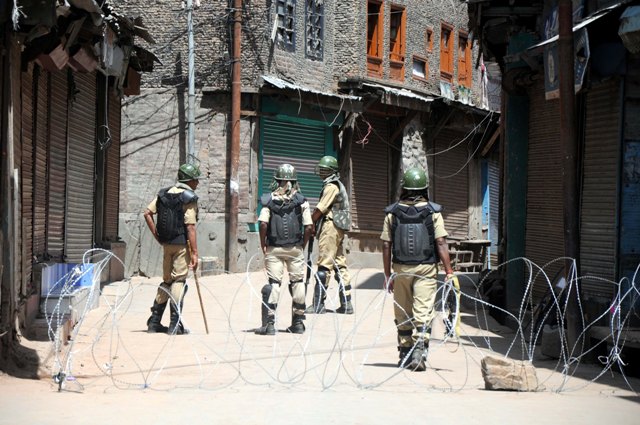
Children’s Right to Education must be protected in Kashmir: Amnesty International
Since July, at least 25 schools have been completely or partially burnt across 10 districts.
Three schools were set on fire on 29 and 30 October. Nobody has been injured or killed in the attacks, which have mostly taken place at night, and the motivation for the attacks remains unclear.
No group has claimed responsibility. The state police have arrested 22 suspects in recent weeks.
“Schools should be safe spaces under all circumstances. The vicious arson attacks on schools end up denying children in Kashmir their right to education. This disturbing trend must stop,” said Aakar Patel, Executive Director, Amnesty International India.
The Jammu and Kashmir High Court has asked the state government to immediately take preventive measures. The Director of School Education in Kashmir told Amnesty International India, “It is difficult for us to protect all the school buildings as they are scattered all over the geographical areas of the valley… We are trying to involve local village and mosque committees in the protection of the schools.”
“The right to education of children in Kashmir can also be hampered by the use of schools for military purposes,” said Aakar Patel. “The presence of security forces in schools can increase the risk of them being attacked, and the long-term occupation of schools can increase dropouts and lower student enrolment and teacher recruitment.”
According to authorities, paramilitary forces have set up camps in at least seven schools in Kashmir since August. The government has shifted some of the venues of upcoming school examinations away from schools occupied by security forces.
In 2010, India’s National Commission for the Protection of Child Rights set out guidelines for the “protection of children’s rights in areas of civil unrest”. The guidelines state that the use of schools by security forces “violates the spirit and letter of the [Right to Education Act] because it actively disrupts access to education and makes schools vulnerable to attacks”.
The Supreme Court has in the past ordered security forces to vacate schools in Chhattisgarh and states in north-east India.
India is obligated under international law to respect, protect and fulfil children’s right to education.
In 2014, the Committee on the Rights of the Child, which monitors the implementation of the Convention on the Rights of the Child (CRC), to which India is a state party, expressed serious concern about the occupation of schools by security forces in India.
In 2015, the UN Security Council expressed “deep concern that that the military use of schools in contravention of applicable international law may render schools legitimate targets of attack, thus endangering the safety of children”, and encouraged member states “to take concrete measures to deter such use of schools by armed forces and armed groups.”
Over 50 countries have endorsed the Safe Schools Declaration, which calls for improving protection of schools, students and teachers during armed conflict, and includes a commitment to carry out the Guidelines for Protecting Schools and Universities from Military Use During Armed Conflict.
Support Our Journalism
We cannot do without you.. your contribution supports unbiased journalism
IBNS is not driven by any ism- not wokeism, not racism, not skewed secularism, not hyper right-wing or left liberal ideals, nor by any hardline religious beliefs or hyper nationalism. We want to serve you good old objective news, as they are. We do not judge or preach. We let people decide for themselves. We only try to present factual and well-sourced news.
Support objective journalism for a small contribution.