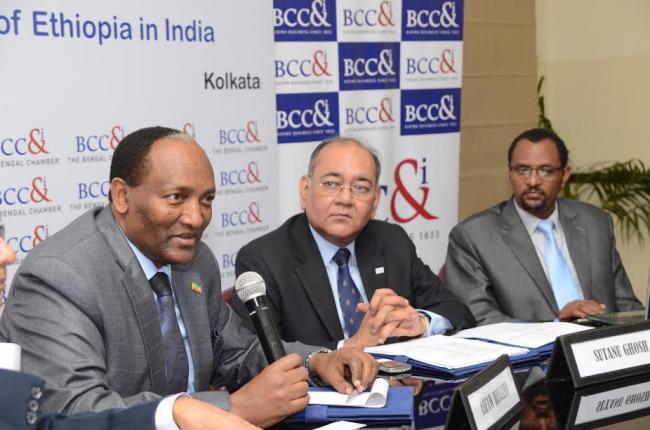
Bengal Chamber of Commerce and Industry,Embassy of Ethiopia host interactive session with Asfaw Dingamo
India and Ethiopia have long-standing economic and commercial relations, which are centuries old and can be traced back over 2000 years of recorded history.
During the Axumite Kingdom, Indian traders had links with the ancient port of Adulis in the eastern part of Ethiopia and traded silk and spices for gold and ivory.
In recent years, with the opening up of the Ethiopian economy, business ties between the two countries have grown significantly, especially in the areas of trade, investment, agriculture and infrastructure projects. The economic dimension of the bilateral relationship has now become most important.
 Iron & Steel Products are India’s major export items to Ethiopia, accounting for 17.2% of India’s total exports to Ethiopia. It was followed by rice (12.7%), pharmaceuticals (10.6%), transport equipment (5.6%), machineries (5.5%), sugar (5.2%), paper products (4.5%), plastics (3.3%), rubber (3.2%), textile and clothings (3.0%), etc.
Major imports by India from Ethiopia were: pulses, precious and semi precious stones, vegetables & seeds leather and spices.
India is the second most important source of imports for Ethiopia, contributing 7.4% of all of Ethiopia’s imports next to China.
There is no Ethiopian Investment in India. However the Indian companies maintained their reputation as being in the top three foreign investors in Ethiopia with newer Indian multinationals marking their presence in Ethiopia.
Indian companies have invested in various sectors like agriculture and floriculture, engineering, power, plastics, manufacturing, cotton and textiles, water management, consultancy and ICT, education, pharmaceuticals and healthcare. About 44% of Indian investment is in the manufacturing sector, followed by agriculture (35%).
Support Our Journalism
We cannot do without you.. your contribution supports unbiased journalism
IBNS is not driven by any ism- not wokeism, not racism, not skewed secularism, not hyper right-wing or left liberal ideals, nor by any hardline religious beliefs or hyper nationalism. We want to serve you good old objective news, as they are. We do not judge or preach. We let people decide for themselves. We only try to present factual and well-sourced news.
Support objective journalism for a small contribution.