 Doklam
'Beijing has equal say in resolving dispute': Bhutan takes u-turn on Doklam issue
In an apparent change of stand on the Doklam issue, Bhutan's Prime Minister Lotay Tshering has said Beijing’s involvement carries equal weight in finding a solution to the dispute over the high-altitude plateau.
Tshering has stressed there are “three of us”—India, Bhutan and China—who need to sit down and discuss resolving the problem.
''It is not up to Bhutan alone to solve the problem,'' said Prime Minister Lotay Tshering in an interview with the Belgian daily La Libre, reported NDTV. ''There are three of us. There is no big or small country, there are three equal countries, each counting for a third.''
Tshering’s assertion that China, too, has a stake in resolving the dispute is in contrast to India’s stance that Beijing has been illegally occupying the area.
The Bhutanese prime minister’s statement is a matter of deep concern for New Delhi because of Doklam’s proximity to the crucial Siliguri corridor, which acts as a narrow buffer separating India's Northeastern states from the rest of the country.
In 2019, Tshering told The Hindu that ''no side'' should do anything near the existing trijunction point between the three countries ''unilaterally"
Now, Bhutan's Prime Minister says, ''We are ready. As soon as the other two parties are ready too, we can discuss.''
The shift indicates that Thimphu is open to discussing the status of the tri-junction in Doklam between India, China and Bhutan, which lies at the centre of the dispute.
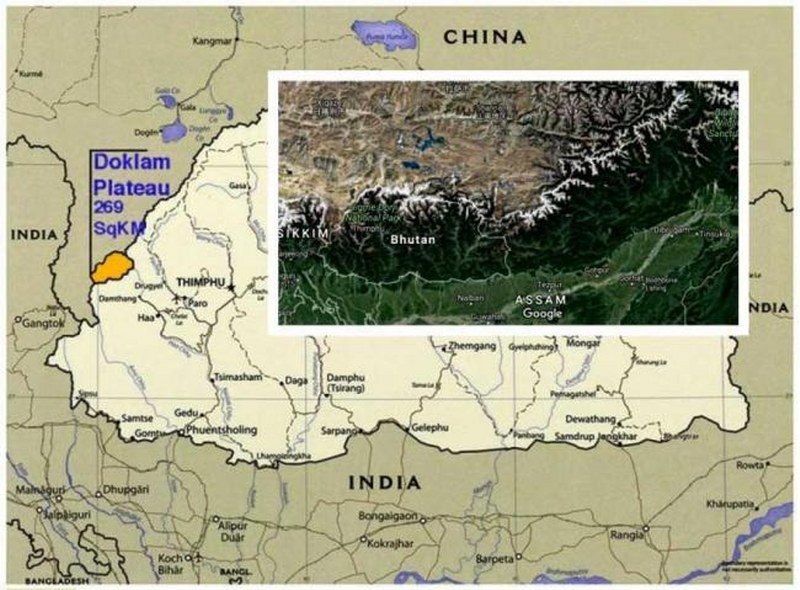
The trijunction point, which is shown on global maps for many years, is located at Batang La. China's Chumbi Valley is situated north of Batang La, Bhutan is situated to the south and east, and India's Sikkim state is located to the west.
However, China wants to shift the trijunction 7 km south of Batang La to a point called Mt Gipmochi.
In that case, the entire Doklam plateau would come under China's legal jurisdiction, which would be unacceptable to New Delhi.
In 2017, a tense confrontation between Indian and Chinese soldiers lasted over two months. The Indian soldiers had entered the Doklam plateau to halt China's unlawful construction of a road leading to Mount Gipmochi and the Jhampheri ridge.
The Indian Army's stance is unequivocal - the Chinese Army cannot be permitted to occupy Jhampheri, as it would provide them unobstructed access to the Siliguri corridor.
Support Our Journalism
We cannot do without you.. your contribution supports unbiased journalism
IBNS is not driven by any ism- not wokeism, not racism, not skewed secularism, not hyper right-wing or left liberal ideals, nor by any hardline religious beliefs or hyper nationalism. We want to serve you good old objective news, as they are. We do not judge or preach. We let people decide for themselves. We only try to present factual and well-sourced news.
Support objective journalism for a small contribution.