 Baba Farid Agman Purab Festival
Baba Farid Agman Purab Festival: Homage to the eponym of Faridkot
Every year, Baba Farid Agman Purb is celerated as a week-long cultural fair as a homage to the great sufi saint Farid-ud-din Masud Ganj-E-shakar, popularly known as Baba Farid or Sheikh Farid.
He is said to have visited this place during these days of September in the thirteenth century (1215) when the town was named after him.
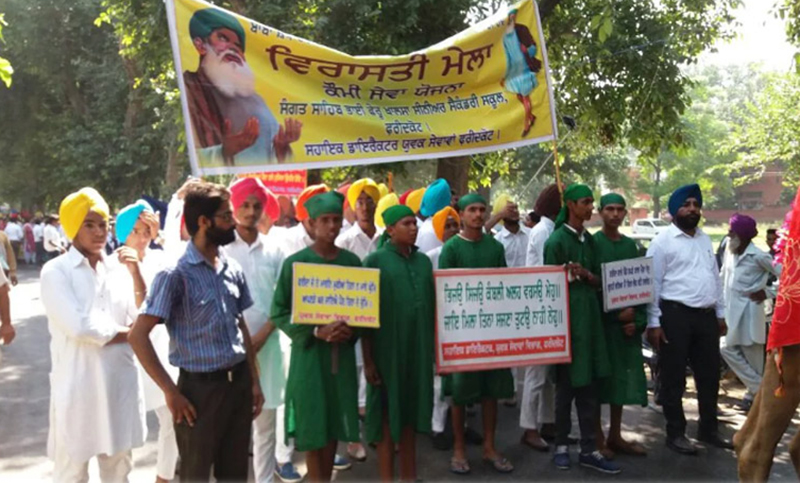
The fair is organised by the district administration and supported by other socio-cultural organisations and it includes religious and cultural events and sports.
Beginning with the recitation of Sukhmani Sahib and the Sikh prayer at Gurdwara Chilla Baba Farid. It is attended by Sikhs, Hindus and Muslims alike.
During the festival the teachings of Baba Farid are explained to the audience in the congregation and illustrated by organising blood donation camp, free community food service and Sufi singing etc.
Other events organised during the festival include nagar Kirtan, book exhibition, heritage walk, kavi darbar, drama, kirtan darbar, folk dances and sports competitions like gatka, hockey, wrestling, kabaddi, football, cricket, volleyball etc.
The eponym of Faridkot, Baba Sheikh Farid, according to a legend, had halted here en route from Delhi to Pakpattan.
The town was then called Mokalhar ruled by the King Mokalsi. When Baba Farid came here, the construction work of the fort, the present Qila Mubarak, was in progress.
Finding him roaming idle, the royal police of the King drafted him in forced labour for construction of the fort.
When found that he was a saint, he was taken to the King who apologised and set him free. Impressed by the knowledge and spiritual power of Baba Sheikh Farid, the King named the town after him and changed it from Mokalhar to Faridkot.
Bābā Farīd , a 12th-13th century Sufi saint, is the first major Punjabi poet whose compositions i.e. hymns constitute a part of the Holy book of the Sikhs, Guru Granth Sahib.
While compiling the Adi Granth in 1604, the fifth Guru of the Sikhs, Guru Arjun Dev Ji selected over one hundred hymns composed by Farid to include in the scripture that was original to the present day Guru Granth Sahib. Besides the compositions by the Sikh Gurus, the writings by 15 Bhagats are also included in Guru Granth Sahib and Baba Farid is one of the revered Bhagats.
Baba Farid wrote poetry in Persian, Arabic, Punjabi and the local Hindawi dialect.
It is noteworthy that he chose to write poetry in Punjabi when it was considered a less refined language. Although preceded by anonymous ballads written in Punjabi, Baba Farid thus laid the foundation of a vernacular Punjabi literature.
He was born in 1178 in the village Kothewal near Multan. He travelled several religious places before he became a disciple of Khwaja Qutubddin Bakhtiar Kaki. After the death of his Peer (Guru), he became his spiritual successor and settled in Ajodhan, the present day Pak Pattan in the present day Pakistan. He is one of the founding fathers of the Chishti Sufi order.
Like the other Sufi saints, Baba Farid was straight forward and truthful. He fearlessly expressed and advocated what he thought was right. According to one of his Mureeds, Hazrat Khwaja Badruddin Ishaq, “Whatever he said, he did and whatever he did, he said”.
His devotees included both rich and poor: he treated them alike with no prejudice. He was sweet in conversation with everyone; hence called Ganj-e-Shakar. He lived a simple life and distributed all that he received in offerings among the poor on the same day. His compositions draw on ordinary experience for the imagery to express ideology and thought. For example,
O Farid! The eyes that infatuated the world, I see them again.
The eyes that couldn’t bear collyrium, there the birds hatch eggs.
(Image and text credit: Khalsavox.com)
Support Our Journalism
We cannot do without you.. your contribution supports unbiased journalism
IBNS is not driven by any ism- not wokeism, not racism, not skewed secularism, not hyper right-wing or left liberal ideals, nor by any hardline religious beliefs or hyper nationalism. We want to serve you good old objective news, as they are. We do not judge or preach. We let people decide for themselves. We only try to present factual and well-sourced news.