American-German trio wins Nobel Prize for Chemistry
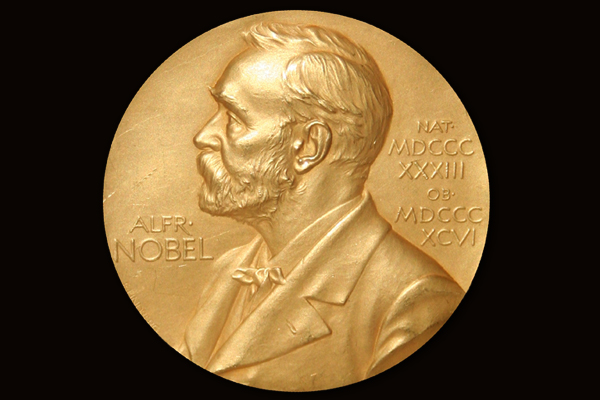
According to reports, The Royal Swedish Academy of Sciences announced the winners of the Nobel Prize in Chemistry for the year 2014.
According to it, American scientists Eric Betzig and William Moerner and Germany's Stefan Hell won the coveted award.
They were recognized for the development of super-resolved fluorescence microscopy.
The trio's research "ground-breaking work has brought optical microscopy into the nano-dimension," the Academy said.
“Back in 1873, science believed it had reached a limit in how much more of a detailed picture a microscope could provide. At the time, miscroscopist Ernst Abbe said that we had reached the maximum resolution. This year's winners proved that contention wrong. Due to their achievements the optical microscope can now peer into the nano-world," the committee said.
It added, “The importance can't be overemphasized: Now, scientists can see how proteins in fertilized eggs divide into embryos, or track proteins involved in Alzheimer's or Parkinson's diseases."
The research group will split the 8 million Swedish Kronas (US$1.1 million or 870,000 Euros) in prize money. They will receive their prize in Stockholm on December 10 at a formal ceremony.
It is noteworthy to mention that this year’s Nobel winners in each sector, so far declared have gone to groups of three.
On Monday, a trio of brain researchers won the Nobel prize for medicine for discovering an "inner GPS," referring to the function in the brain that "makes it possible to orient ourselves in space, demonstrating a cellular basis for higher cognitive function."
On Tuesday, three researchers in the field of physics were recognized for inventing the energy-saving, blue-light emitting diodes, commonly known as LEDs.
On Wednesday Eric Betzig and William Moerner and Germany's Stefan Hell won the Nobel Prize in Chemistry.
As a matter of fact, Last year's prize in Chemistry was also rewarded to three scientists, Martin Karplus, Michael Levitt and Arieh Warshel, for work leading to the computer programs used today to predict the outcomes of very complex chemical reactions.
Support Our Journalism
We cannot do without you.. your contribution supports unbiased journalism
IBNS is not driven by any ism- not wokeism, not racism, not skewed secularism, not hyper right-wing or left liberal ideals, nor by any hardline religious beliefs or hyper nationalism. We want to serve you good old objective news, as they are. We do not judge or preach. We let people decide for themselves. We only try to present factual and well-sourced news.
Support objective journalism for a small contribution.