 Amit Shah
After 75 years, Lord Buddha’s sacred relics return to Ladakh — Amit Shah calls it a ‘golden moment’
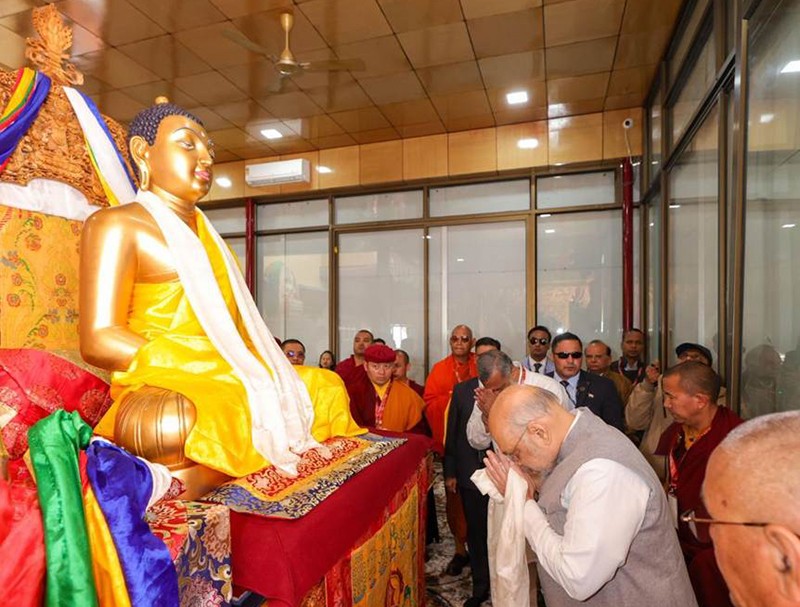
Union Home Minister and Minister of Cooperation Amit Shah on Friday inaugurated the exposition of the sacred relics of Gautama Buddha in Leh.
On the occasion, Lieutenant Governor of Ladakh V.K. Saxena, the Union Home Secretary, and several dignitaries were present.
Addressing the gathering, Amit Shah described Buddha Purnima as a historic and “golden occasion” for the people of Ladakh. He noted that the arrival of the sacred relics after 75 years on such an auspicious day would inspire followers of Buddhism and people of other faiths alike.
He highlighted the unique significance of the day, observing that in the life of Lord Buddha, it is rare for birth, enlightenment, and Mahaparinirvana to be commemorated on the same day, making the occasion deeply meaningful and inspiring.
Shah said the event was not only religious but also a historic reunion. “After so many years, Tathagata Buddha has returned to this sacred land—his most beloved land—which is a matter of great fortune,” he remarked.
Emphasizing Ladakh’s rich spiritual legacy, Shah described it as a “living land of Dhamma” for centuries. He recalled that Dalai Lama has often referred to Ladakh as not merely a geographical region but a living laboratory of Buddhist culture and compassion.
He added that Ladakh’s spiritual identity has been shaped by four major Buddhist traditions—Nyingma, Kagyu, Sakya, and Gelug—and that the message emerging from this land continues to guide the world.
The Home Minister said the presence of the sacred relics serves as a reminder that India’s civilization has long upheld the values of peace and coexistence. In diverse regions like Ladakh and Kargil, he noted, this message holds even greater relevance, demonstrating that compassion and harmony remain the path to resolving conflict.
Tracing the historical journey of Buddhism in Ladakh, Shah said the region has long been a center for Buddhist studies, including Mahayana Buddhism philosophy and art. He credited the envoys of Ashoka with laying the early foundations of Buddhist influence in the region.
He further noted that during the Kushan period (1st to 3rd centuries), Mahayana Buddhism flourished in Ladakh, as evidenced by ancient stupas, idols, and Kharosthi-Brahmi inscriptions.
Highlighting the importance of trade routes, Shah said the Silk Route linking Kashmir, Leh, Yarkand, Khotan, and Tibet facilitated not just commerce but also cultural and intellectual exchange.
Between the 7th and 10th centuries, Mahayana and Vajrayana traditions reached Ladakh from Tibet, further enriching its spiritual heritage. In the 10th and 11th centuries, the translation of Sanskrit texts into Tibetan and the establishment of 108 monasteries—including the Alchi Monastery—gave Buddhism a strong institutional foundation in the region.
Shah said that even today, Buddhist traditions across the world draw significantly from the knowledge preserved in Ladakh. Citing Mahayana literature, he noted that witnessing sacred relics is considered equivalent to having the darshan of Lord Buddha himself. He urged the Ladakh administration to ensure proper arrangements for devotees of all faiths to visit and pay their respects.
Concluding his address, Amit Shah said that while the teachings of Lord Buddha were highly relevant when first disseminated over 2,500 years ago, they are even more significant in today’s world. He called on the global community to embrace India’s spiritual heritage and follow the path of the Middle Way—rooted in balance, peace, and solutions.
Support Our Journalism
We cannot do without you.. your contribution supports unbiased journalism
IBNS is not driven by any ism- not wokeism, not racism, not skewed secularism, not hyper right-wing or left liberal ideals, nor by any hardline religious beliefs or hyper nationalism. We want to serve you good old objective news, as they are. We do not judge or preach. We let people decide for themselves. We only try to present factual and well-sourced news.