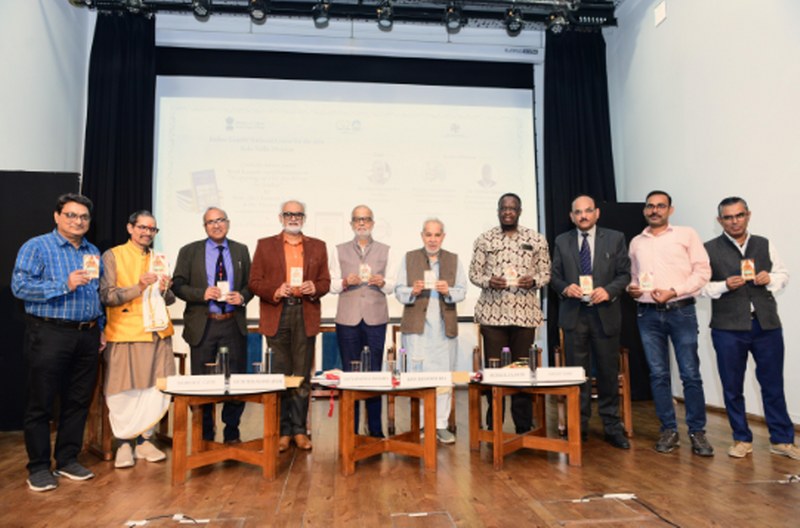
 Book launch
Experts appreciate launch of book on mapping of the archives in India by IGNCA and UNESCO
New Delhi/IBNS: There is crucial need for continuous and diligent efforts in mapping the archives existing in India, said Dr. Sanjay Garg, Deputy Director, National Archives of India.
He was addressing the gathering at the launch of the book titled ‘Mapping of the Archives in India’ and discussions around it.
The programme was organised by the Indira Gandhi National Centre for the Arts (IGNCA), Kalanidhi Division.
The book, authored by Prof. Ramesh Chandra Gaur and Vismay Basu, is published by IGNCA and UNESCO.
On this occasion a descriptive e- Catalogue of ‘Aagam- Tantra- Mantra- Yantra, Khand- 3, Bhag – 1-5’ was also launched.
The book launch session was chaired by Ram Bahadur Rai, President, IGNCA Trust.
Satyananda Mishra, former Chief Information Commissioner of India and Hezekiel Dlamini, Advisor Communication and Information for South Asia UNESCO, New Delhi Office were the guests of honour.
Speakers at the event included Dr. Sachchidanand Joshi, Member Secretary, IGNCA, Prof. Dr. Ramesh Chandra Gaur, Director (L&I) & Kalanidhi Division, IGNCA and Dr. Sanjay Garg, Deputy Director, National Archives of India.
In his welcome address, Prof. Ramesh Chandra Gaur said that the project commenced in 2018 and formally initiated in 2019 but was delayed due to the onset of the pandemic.
Through an extensive survey of literature, they identified 600 institutions across the country housing archives, resulting in the creation of 424 directories within the book, he said.
These directories encompass comprehensive profiles of the contained archives, shedding light on aspects of conservation, digitization, and archival perspectives.
Prof. Gaur stressed the dire need for archival science education in India, emphasizing that these archives represent India’s legacy and must be safeguarded.
Referring to the 'Panch Pran' (five resolves) referred to by the Prime Minister of India, Narendra Modi, he underlined the significance of preserving the country’s heritage and urged for a mindful approach to ensure its longevity through effective archiving.
Dr. Sanjay Garg, in his address, emphasized the historical significance of archives in the country, highlighting the crucial need for continuous and diligent efforts in mapping these archives.
He elaborated on the diverse dispersal mechanisms of archives, citing the pivotal role played by religious institutions, educational and princely estates, state archives, and corporate archives.
Dr. Garg said that banks, judicial systems, and custodial establishments too have a massive collection of archives and the vast heritage is at risk of being lost in absence of proper archiving mechanism in place.
Dr. Sachchidanand Joshi lamented the lack of inclination towards archival science, attributing it to the predominant focus on the present moment, resulting in inadequate archiving and documentation, leading to a scarcity of evidence concerning India’s rich historical knowledge.
Hezekiel Dlamini too emphasized on the historical significance of archives, and how knowledge and culture form the bedrock of history.
"India as a dynamic and vibrant amalgamation of culture attracts the world to it," he said.
Satyanand Mishra highlighted the profound impact of utilizing archival materials in reviving the past, underlining its importance in understanding and reconstructing history.
Ram Bahadur Rai, apart from appreciating the book, also focused on the necessity of reopening of closed libraries and questioned the accessibility of information within archives and libraries in the country.
Support Our Journalism
We cannot do without you.. your contribution supports unbiased journalism
IBNS is not driven by any ism- not wokeism, not racism, not skewed secularism, not hyper right-wing or left liberal ideals, nor by any hardline religious beliefs or hyper nationalism. We want to serve you good old objective news, as they are. We do not judge or preach. We let people decide for themselves. We only try to present factual and well-sourced news.
Support objective journalism for a small contribution.