


Working towards 'seamless' infrared maps of Titan
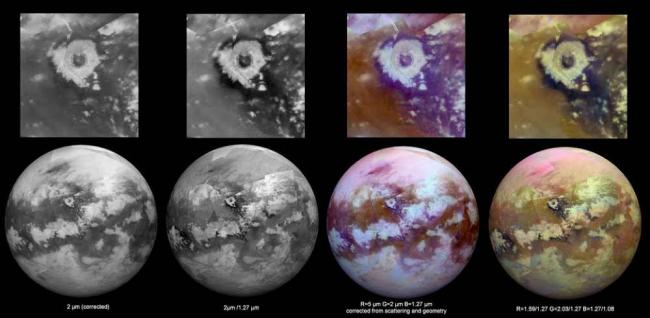
These views demonstrate some of the progress researchers have made in creating smooth-looking maps of Titan from the multitude of different VIMS observations made under a wide variety of lighting and viewing conditions, read the NASA website.
Cassini has flown past Titan about once per month, on average, since 2004, in order to observe the giant moon and to take advantage of its gravity for shaping the spacecraft's trajectory. With each flyby, VIMS has a brief opportunity to add small pieces to the instrument's overall mapping coverage of Titan.
Producing a seamless global map of Titan is a challenging task, because observing conditions can vary greatly between each flyby. Among these variations are changes in the angle of the sun with respect to the surface and in the spacecraft's viewing direction. Such variations can make it even more difficult to remove the effects of scattering and absorption of light by Titan's thick, hazy atmosphere. These effects can also influence how bright different areas of the surface appear. Seasonal changes may also have played a role in changing the appearance of Titan's surface over the course of Cassini's long mission. These factors create a complex problem that researchers are still working to solve.
In each montage, the images from left to right present different views that demonstrate the broad spectral capability of the VIMS instrument. The upper row of images in each montage shows a particular region of interest; one features the 50-mile-wide (80-kilometer-wide) Sinlap impact crater, while the other focuses on the region surrounding the landing site for ESA's Huygens probe. The lower row of images features maps of the hemispheres in which these regions are located.
The images at far left show the surface at 2 microns, a wavelength where the atmosphere is quite transparent to infrared light.
The views at the next position are spectral ratio images -- in which an image at one wavelength is divided by an image at another wavelength. This technique can be used to emphasize subtle spectral variations on the surface, some of which are related to differences in composition.
The third view is a color composite with light at 5 microns shown in red, 2 microns shown in green and 1.27 microns shown in blue. (All component images were corrected for atmospheric and photometric effects.)
The final (rightmost) views are color composites created using ratios that divide the brightness of the surface in one set (or band) of wavelengths by that of another set in order to produce the red, green and blue channels of a color composite image. Like spectral ratio images, these images may reveal differences in the nature of surface materials.
The Cassini mission is a cooperative project of NASA, ESA (the European Space Agency) and the Italian Space Agency.
The Jet Propulsion Laboratory, a division of the California Institute of Technology in Pasadena, manages the mission for NASA's Science Mission Directorate, Washington.
The Cassini orbiter and its two onboard cameras were designed, developed and assembled at JPL. The visual and infrared mapping spectrometer team is based at the University of Arizona.
Image: NASA
Support Our Journalism
We cannot do without you.. your contribution supports unbiased journalism
IBNS is not driven by any ism- not wokeism, not racism, not skewed secularism, not hyper right-wing or left liberal ideals, nor by any hardline religious beliefs or hyper nationalism. We want to serve you good old objective news, as they are. We do not judge or preach. We let people decide for themselves. We only try to present factual and well-sourced news.
Support objective journalism for a small contribution.


