


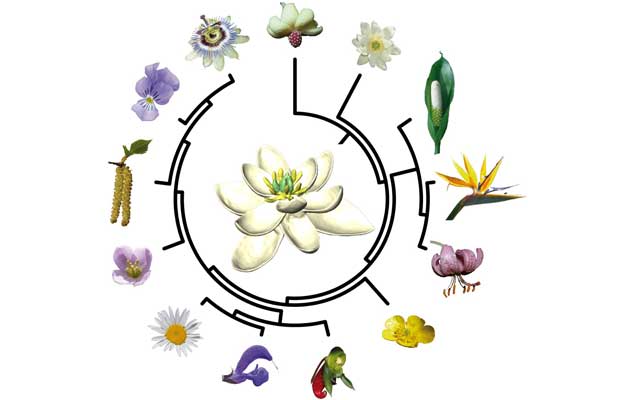
What did the mother of all flowers look like?
A study published today in Nature Communications by a team of 36 researchers from 13 countries reconstructs the evolution of flowers over the past 140 million years and sheds new light on what the earliest flowers might have looked like.
This study into the evolution of flowering plants, called the eFLOWER project, is an unprecedented international effort to combine information on the structure of flowers with the latest information on the evolutionary tree of flowering plants based on DNA.
The results provide insights into the early evolution of flowers as well as major patterns in floral evolution across all living flowering plants.
Charles Foster, a PhD student at the University of Sydney and co-author of the study, said the project exemplified the “power and importance of collaboration” to address some of the fundamental questions in science.
"Participating in such a global, inter-institutional effort was very inspirational for me as a young scientist," said Mr Foster, from the School of Life and Environmental Sciences in the Faculty of Science.
Flowering plants (angiosperms), with at least 300,000 species, are by far the most diverse group of plants on Earth. They include almost all the species used by people for food, medicine, and many other purposes.
But flowering plants arose only about 140 million years ago, quite late in the evolution of plants, toward the end of the age of the dinosaurs, but since then have diversified spectacularly.
No one knows exactly how this happened, and the origin and early evolution of flowering plants and especially flowers still remain one of the biggest enigmas in biology, almost 140 years after Charles Darwin called their rapid rise in the Cretaceous “an abominable mystery”.
The new study is based on the largest database of floral traits ever assembled, which took six years to coordinate, double-check, and analyse. Among the most surprising results is a new model of the original ancestral flower that does not match any of the ideas proposed previously.
“When we finally got the full results, I was quite startled until I realized that they actually made good sense”, said Hervé Sauquet, the leader of the study and an Associate Professor at Université Paris-Sud in France.
The ancestral flower was found to be bisexual, with both female (carpels) and male (stamens) parts, and with multiple whorls (concentric cycles) of petal-like organs, in sets of threes. About 20% of flowers today have such ‘trimerous’ whorls, but typically fewer: lilies have two, magnolias have three.
“These results call into question much of what has been thought and taught previously about floral evolution,” said Jürg Schönenberger, a Professor at the University of Vienna, who coordinated the study together with Associate Professor Sauquet. It had long been assumed that the ancestral flower had all organs arranged in a spiral.
The researchers also reconstructed what flowers looked like at all the key divergences in the flowering plant evolutionary tree, including the early evolution of monocots, for example orchids, lilies, and grasses; and eudicots such as poppies, roses, and sunflowers – the two largest groups of flowering plants.
The database of floral features was assembled using a novel approach because of the need for not only a new collaborative database but also much more rapid data entry. The solution was a “summer camp” for advanced botanical students, who scored half of all the data during a single week at the University of Vienna. Twelve students from different countries were invited to work together for one week.
The findings offer for the first time a simple, plausible scenario to explain the spectacular diversity of floral forms.
Image Credit: Hervé Sauquet and Jürg Schönenberger.
Support Our Journalism
We cannot do without you.. your contribution supports unbiased journalism
IBNS is not driven by any ism- not wokeism, not racism, not skewed secularism, not hyper right-wing or left liberal ideals, nor by any hardline religious beliefs or hyper nationalism. We want to serve you good old objective news, as they are. We do not judge or preach. We let people decide for themselves. We only try to present factual and well-sourced news.
Support objective journalism for a small contribution.


