


 Kenya Vaccine
Vaccines for all key to building back better after COVID-19: Kenyan President
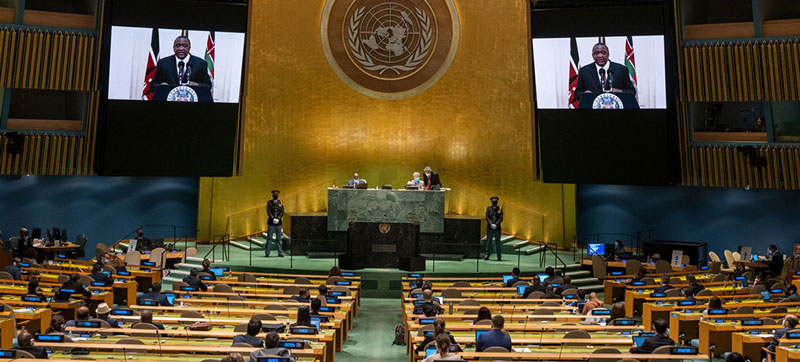
New York: Equitable global access to vaccines must be at the core of efforts to build back better from the COVID-19 pandemic, Kenyan President Uhuru Kenyatta told the UN General Assembly on Wednesday.
“To rebuild successfully requires a worldwide response in confidence and investment to enable production and consumption to bounce back to pre-pandemic levels,” he said in a pre-recorded message.
“The surest way to building that confidence is by making vaccines available to the world, in an equitable and accessible manner.”
However, he said the current “asymmetry” in vaccine supply “reflects a multilateral system that is in urgent need of repair.”
Increase investment and tech transfers
Therefore, building back better must see the international community making concerted, structural changes to enable a “quantum increase” in investment and technology transfers.
This would not be “charity”, but driven by enlightened self-interest and solidarity.
“A fast-developing Africa will offer the entire world the benefit of its demographic dividend of youth and vast investment opportunities,” he said.
“Africa can become an engine of sustainable global growth and an exporter of peace and stability and transformative prosperity.”
Building back ‘green’
With economic recovery linked to climate action, and the COP26 UN climate conference fast approaching, President Kenyatta highlighted the need for clear commitments to assist developing country investments in “green” manufacturing.
“A ‘Green Building Back Better’ that delivers jobs and shared prosperity, will win the support of the young generation and intensify the drive towards climate change action,” he added.
The President outlined steps Kenya is taking to become a leading “green industry” country, starting with plans to lower greenhouse gas emissions by 32 per cent by 2030, in line with national commitments under the Paris Agreement for climate change.
Kenya has also implemented a multi-year strategy to pursue higher economic growth while supporting a low-carbon development path.
Manage diversity, strengthen trust
Turning to other matters on the international agenda, President Kenyatta noted that in many countries, state fragility is leading to protracted crises.
This fragility was mainly due to an inability to manage diversity within nations, he said, thus providing militant and terrorist groups with opportunities to create social discontent and control large swaths of territory.
“The tools to deal with these crises are not proving adequate, so we must work to improve their capabilities,” he said.
“The most important task we can undertake is to increase the competence of states to manage both political and social diversity within their nation states. Indeed, countries must do so in a way that strengthens the trust between citizens and public institutions and citizens and their leaders.”
President Kenyatta said his own country’s “tough experiences”, and determination to rise above them, could serve as a good case study for other nations.
Support Our Journalism
We cannot do without you.. your contribution supports unbiased journalism
IBNS is not driven by any ism- not wokeism, not racism, not skewed secularism, not hyper right-wing or left liberal ideals, nor by any hardline religious beliefs or hyper nationalism. We want to serve you good old objective news, as they are. We do not judge or preach. We let people decide for themselves. We only try to present factual and well-sourced news.
Support objective journalism for a small contribution.


