


 Nobel Prize
Trio wins Nobel Prize in Chemistry for developing new form of molecular architecture
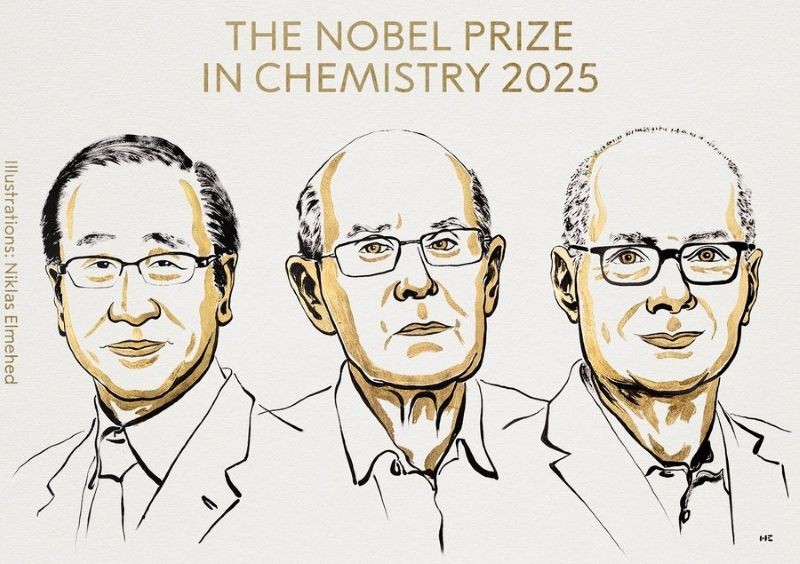
Scientists Susumu Kitagawa, Richard Robson and Omar Yaghi have won the Nobel Prize in Chemistry for developing a new form of molecular architecture.
In their constructions, metal ions function as cornerstones that are linked by long organic (carbon-based) molecules.
"Together, the metal ions and molecules are organised to form crystals that contain large cavities. These porous materials are called metal–organic frameworks (MOF)," the award giving organisation said in a statement.
By varying the building blocks used in the MOFs, chemists can design them to capture and store specific substances. MOFs can also drive chemical reactions or conduct electricity.
“Metal–organic frameworks have enormous potential, bringing previously unforeseen opportunities for custom-made materials with new functions,” says Heiner Linke, Chair of the Nobel Committee for Chemistry.
It all started in 1989, when Richard Robson tested utilising the inherent properties of atoms in a new way.
He combined positively charged copper ions with a four-armed molecule; this had a chemical group that was attracted to copper ions at the end of each arm.
When they were combined, they bonded to form a well-ordered, spacious crystal. It was like a diamond filled with innumerable cavities.
Robson immediately recognised the potential of his molecular construction, but it was unstable and collapsed easily.
However, Susumu Kitagawa and Omar Yaghi provided this building method with a firm foundation; between 1992 and 2003 they made, separately, a series of revolutionary discoveries.
Kitagawa showed that gases can flow in and out of the constructions and predicted that MOFs could be made flexible.
Yaghi created a very stable MOF and showed that it can be modified using rational design, giving it new and desirable properties.
Following the laureates’ groundbreaking discoveries, chemists have built tens of thousands of different MOFs.
Some of these may contribute to solving some of humankind’s greatest challenges, with applications that include separating PFAS from water, breaking down traces of pharmaceuticals in the environment, capturing carbon dioxide or harvesting water from desert air.
Support Our Journalism
We cannot do without you.. your contribution supports unbiased journalism
IBNS is not driven by any ism- not wokeism, not racism, not skewed secularism, not hyper right-wing or left liberal ideals, nor by any hardline religious beliefs or hyper nationalism. We want to serve you good old objective news, as they are. We do not judge or preach. We let people decide for themselves. We only try to present factual and well-sourced news.
Support objective journalism for a small contribution.


