


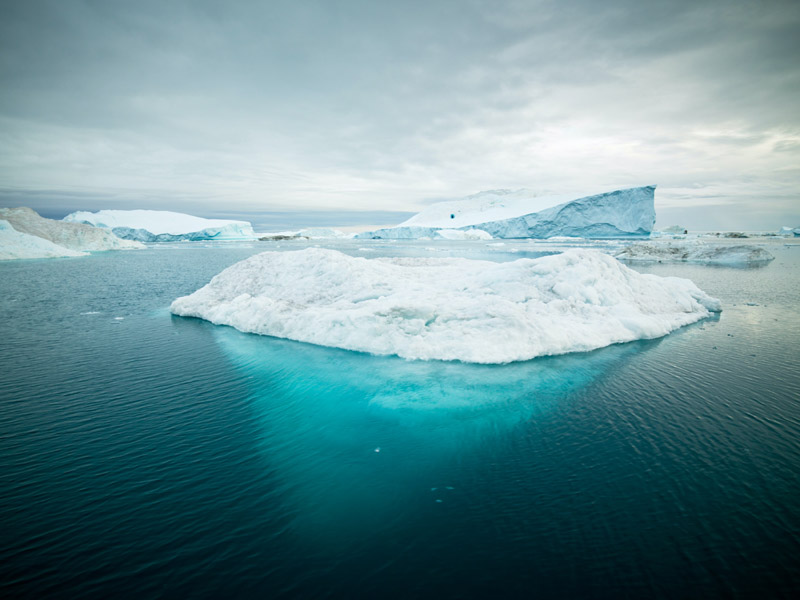
 West Antarctic
Study finds increased West Antarctic ice sheet melting ‘unavoidable’
The West Antarctic Ice Sheet will continue to increase its rate of melting over the rest of the century, no matter how much we reduce fossil fuel use, according to British Antarctic Survey (BAS) research published this week in the journal Nature Climate Change.
A substantial acceleration in ice melting likely cannot now be avoided, which implies that Antarctica’s contribution to sea level rise could increase rapidly over the coming decades.
Scientists ran simulations on the UK’s national supercomputer to investigate ocean-driven melting of the West Antarctic Ice Sheet: how much is unavoidable and must be adapted to, and how much melting the international community still has control over through reduction of greenhouse gas emissions.
Taking into account climate variability like El Niño, they found no significant difference between mid-range emissions scenarios and the most ambitious targets of the 2015 Paris Agreement. Even under a best-case scenario of 1.5°C global temperature rise, melting will increase three times faster than during the 20th century.
The West Antarctic Ice Sheet is losing ice and is Antarctica’s largest contributor to sea-level rise. Previous modelling finds this loss could be driven by warming of the Southern Ocean, particularly the Amundsen Sea region. Collectively the West Antarctic Ice Sheet contains enough ice to raise global mean sea-level by up to five metres.
Around the world millions of people live near the coast and these communities will be greatly impacted by sea level rise. A better understanding of the future changes will allow policymakers to plan ahead and adapt more readily.
Lead author Dr Kaitlin Naughten, a researcher at the British Antarctic Survey says: “It looks like we’ve lost control of melting of the West Antarctic Ice Sheet. If we wanted to preserve it in its historical state, we would have needed action on climate change decades ago. The bright side is that by recognising this situation in advance, the world will have more time to adapt to the sea level rise that’s coming. If you need to abandon or substantially re-engineer a coastal region, having 50 years lead time is going to make all the difference.”
The team simulated four future scenarios of the 21st century, plus one historical scenario of the 20th century. The future scenarios either stabilised global temperature rise at the targets set out by the Paris Agreement, 1.5°C and 2°C, or followed standard scenarios for medium and high carbon emissions.
All scenarios resulted in significant and widespread future warming of the Amundsen Sea and increased melting of its ice-shelves.
The three lower-range scenarios followed nearly identical pathways over the 21st century.
Even under the best-case scenario, warming of the Amundsen Sea sped up by about a factor of three, and melting of the floating ice shelves which stabilise the inland glaciers followed, though it did begin to flatten by the end of the century.
The worst-case scenario had more ice shelf melting than the others, but only after 2045. The authors heed that this high fossil fuel scenario, where emissions increase rapidly, is considered unlikely to occur.
This study presents sobering future projections of Amundsen Sea ice-shelf melting but does not undermine the importance of mitigation in limiting the impacts of climate change.
Naughten cautions: “We must not stop working to reduce our dependence on fossil fuels. What we do now will help to slow the rate of sea level rise in the long term. The slower the sea level changes, the easier it will be for governments and society to adapt to, even if it can’t be stopped.”
Support Our Journalism
We cannot do without you.. your contribution supports unbiased journalism
IBNS is not driven by any ism- not wokeism, not racism, not skewed secularism, not hyper right-wing or left liberal ideals, nor by any hardline religious beliefs or hyper nationalism. We want to serve you good old objective news, as they are. We do not judge or preach. We let people decide for themselves. We only try to present factual and well-sourced news.
Support objective journalism for a small contribution.


