


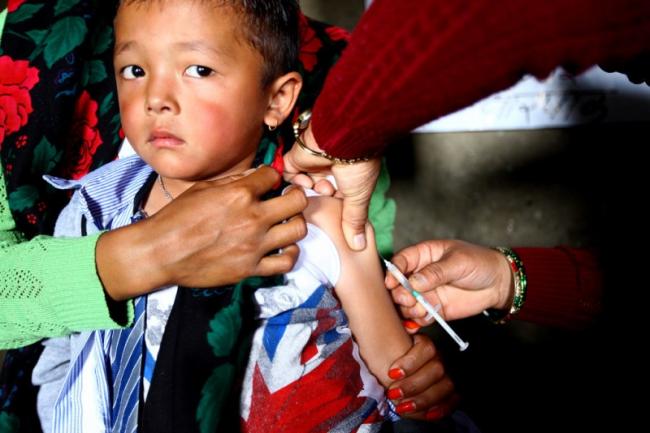
South-East Asia region aims to close immunity gap, wipe out measles by 2020 – UN health agency
New York, Feb 1 (IBNS): The so-called ‘big six’ countries in the World Health Organization’s (WHO) South-East Asia region are meeting today in New Delhi on an accelerated strategy to wipe out measles and rubella in the next three years by targeting as many as 500 million children with vaccines.
Eliminating measles would avert half a million deaths, while controlling rubella and Congenital Rubella Syndrome (CRS) would promote health of pregnant woman and the infants they give life to,” said Dr. Poonam Khetrapal Singh, Regional Director for the World Health Organization (WHO) South-East Asia, referring to the ‘big six;’ Bangladesh, India, Indonesia, Myanmar, Nepal and Thailand.
While Bhutan and Maldives eliminated measles in 2017, other regional countries are carrying out large-scale immunization drives to achieve the same. WHO noted that nearly 4.8 million children in the region miss their measles vaccines every year.
Through routine immunization and supplementary immunization campaigns, over the next two years, nearly 500 million children in Bangladesh, India, Indonesia, Myanmar, Nepal and Thailand are being targeting for measles and rubella vaccines.
According to Dr. Khetrapal Singh, sharing challenges and lessons learned from recent achievements and initiatives will help member countries address their specific problems to close the immunity gap against measles, rubella and CRS.
In recent years, WHO South-East Asia Region has made unprecedented progress against vaccine-preventable diseases: Certified polio-free in 2014 and having eliminated maternal and neonatal tetanus as a public health problem in 2016.
Nearly 38 million children are born in the Region every year, of which approximately 87 per cent receive the first dose of measles-containing vaccine. Though this is a marked improvement from previous years, it still means around 4.8 million children are deprived of the most basic protection against measles each year.Further accelerated and focussed efforts are needed.
Immunization programme managers of the ‘big six’ countries, along with WHO, UN Children’s Fund (UNICEF), Vaccine Alliance (GAVI), Bill and Melinda Gates Foundation and Centre for Disease control are deliberating challenges, experiences and lessons learned in immunization in the Region that can be harnessed to eliminate measles and control rubella / congenital rubella syndrome (CRS).
“This dynamism and positive exchange is at the very core of south-south and triangular cooperation,” said Dr. Khetrapal Singh, who announced measles elimination and rubella / CRS control as one of her flagship programme at the start of her tenure in 2014.
Since then, all South-East Asia Region member countries have introduced two doses of measles-containing vaccines in their childhood immunization programme.
Measles elimination and rubella /CRS control strategies include ensuring over 95 per cent coverage with two doses of measles and rubella containing vaccine in each district through routine and/or supplementary immunization activities, and developing and sustaining sensitive measles surveillance supported by an accredited measles laboratory network.
Eliminating measles and controlling rubella would also mean extending the benefits of vaccine to all people everywhere, including communities in hard-to-reach or remote areas, the underserved or the neglected or marginalized; and advancing universal health coverage.
Photo: UNICEF/Kiran Panday
Support Our Journalism
We cannot do without you.. your contribution supports unbiased journalism
IBNS is not driven by any ism- not wokeism, not racism, not skewed secularism, not hyper right-wing or left liberal ideals, nor by any hardline religious beliefs or hyper nationalism. We want to serve you good old objective news, as they are. We do not judge or preach. We let people decide for themselves. We only try to present factual and well-sourced news.
Support objective journalism for a small contribution.


