


 Spiti
Spiti
Snow Leopards and Dogs: How Himalayan Carnivores Rewire Survival in Spiti
In Spiti Valley’s harsh high-altitude landscape, a new study finds that snow leopards, wolves, foxes and free-ranging dogs coexist by constantly shifting their behaviour — adjusting when and where they are active to avoid conflict amid rising human pressure. With human-subsidised dogs reshaping the predator balance, researchers warn this fragile system may not endure without intervention. Mongabay India correspondent Sneha Mahale reports
High in the Trans-Himalayan landscape of Spiti, life is shaped by extremes. The air is thin, winters plunge to -40°C, and food is scarce for much of the year. For the region’s carnivores — snow leopards, Himalayan wolves, red foxes, and an increasingly visible newcomer, free-ranging dogs — survival depends on navigating a landscape under growing human pressure.
New research shows how these predators are quietly rearranging their lives to coexist. “Studying them together is essential because none of them function in isolation; each species’ behaviour and survival are shaped by the others and by human influence,” says Priyanka Justa, Ph.D. student at the Wildlife Institute of India (WII) and the study’s co-author.
 A view of Kaza, a rapidly growing settlement and tourism centre in Spiti Valley. Image by Priyanka Justa.
A landscape under pressure
Himachal Pradesh’s Spiti Valley lies within the Cold Desert Biosphere Reserve, spanning elevations from about 3,600 to over 6,700 metres. Snow leopards and Himalayan wolves occupy the top of the food web, while red foxes operate as smaller, yet highly adaptable mid-ranking predators. In the recent decades, free-ranging dogs have joined this carnivore group, subsidised by food waste from villages and tourism.
“Spiti is almost a natural stress test for understanding carnivore coexistence. Everything is scarce, seasonal, and highly concentrated. This naturally intensifies competition and makes trade-offs between risk, food, and space much sharper and easier to detect,” says Justa.
For this study, the researchers focused on five areas across Spiti Valley (Chandratal, Kibber, Pin Valley, Mane, and Gue), each differing in tourism intensity, settlements, livestock presence, predator-prey dynamics and the presence of dogs. Together, they represented a gradient of human impact, from heavily visited trekking hubs to relatively restricted border zones.
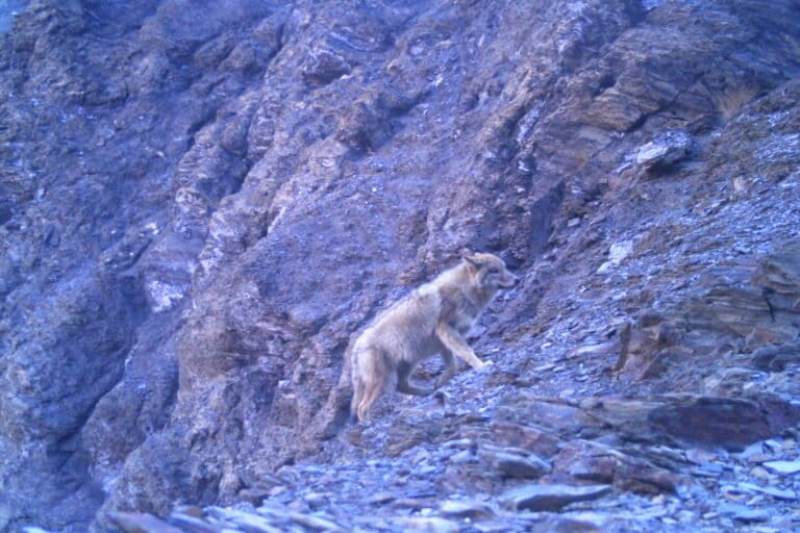 A recent study exploring how carnivores in Spiti Valley coexist revealed that wolves avoided settlements more strongly and preferred less disturbed areas. Image by WII Camera Trap.
Given the animals’ elusive nature and large ranges, the team relied on camera traps to observe them. Over two field seasons between August 2021 and August 2022, they deployed 205 motion-sensitive cameras across the five sites, accumulating more than 8,000 camera-trap days.
Cameras were placed along trails, ridgelines, and areas with signs of animal movement, capturing images day and night. Rather than estimating population sizes, the researchers focused on space use, where species occurred, how often, and under what conditions. “The biggest challenge was that the species we were studying operate at very different spatial scales. To make a single, comparable dataset, we had to design a camera-trap grid that was fine enough to capture foxes and dogs, even though this meant it was coarser than ideal for wide-ranging species like wolves and snow leopards,” says Justa.
Who overlaps, who avoids
The results showed that Spiti’s carnivores share space in uneven ways. Red foxes proved the most flexible, frequently overlapping with other carnivores. They were more common where prey was abundant, even in areas used by snow leopards, wolves, or dogs, likely because foxes can exploit scavenging opportunities.
Dogs, by contrast, stayed close to people, clustering around roads, settlements, and waste sites. These areas became zones of higher risk and competition. “Free-ranging dogs have become a central driver of how the entire system works. They are not just another species in the landscape. Their sheer numbers, driven by human subsidies, are reshaping how native carnivores use space and time,” says Salvador Lyngdoh, scientist at the WII and the study’s corresponding author. While dogs rarely overlapped with snow leopards, they showed an overlap with wolves, largely because both used roads and open terrain.
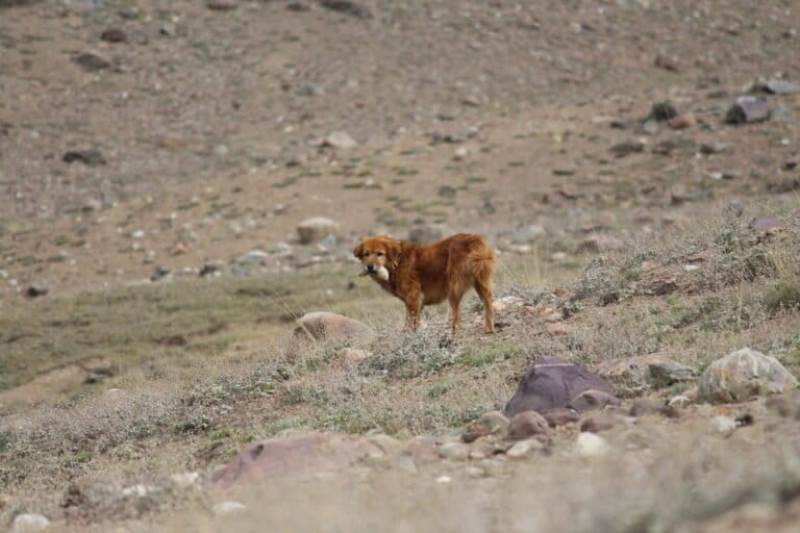 A free-ranging dog with a small animal prey near Chandratal, Spiti Valley. Image by Priyanka Justa.
When the animals could not fully avoid one another in space, they adjusted in time instead. Snow leopards, red foxes, and dogs all showed two daily peaks of activity, but the timing of these peaks shifted. Foxes became more nocturnal in areas with dogs, reducing the chance of encounters. They, however, did not significantly change their behaviour when sharing space with snow leopards. Snow leopards cut back early-morning activity where dogs were common.
“The most surprising result was that snow leopards did not respond to human pressure by simply abandoning human-dominated areas. Instead, they continue to use the same spaces but adjust when they are active,” says Lyngdoh.
Wolves responded differently. They avoided settlements more strongly and preferred less disturbed areas, while dogs showed little behavioural change, regardless of human presence.
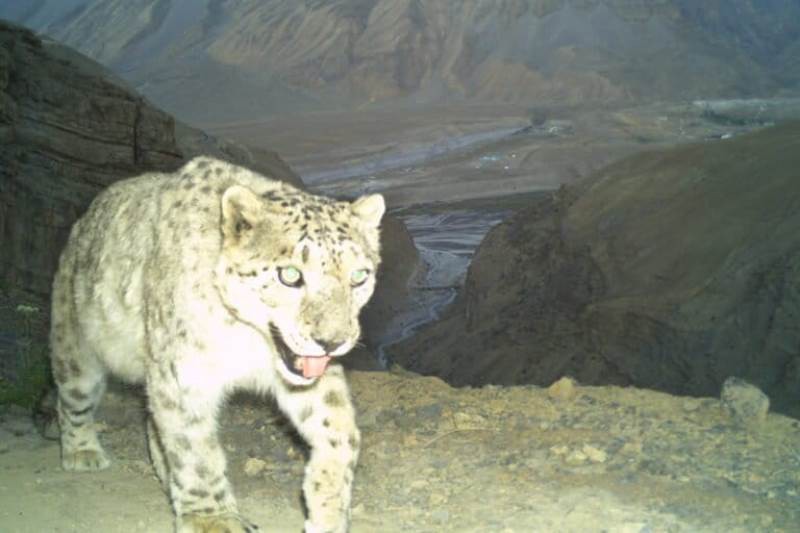 Snow leopards cut back early-morning activities where dogs were common. Image by WII Camera Trap.
Why this matters
The study highlights how carnivores in Spiti are adapting to cope with competition and growing human pressure. It also raises red flags. “Instead of being structured mainly by body size and natural prey, the predator hierarchy is increasingly structured by access to human subsidies and tolerance of human disturbance. Dogs are effectively becoming the dominant carnivore around settlements, foxes persist through flexibility, and apex predators like snow leopards are being pushed into making risky trade-offs,” says Lyngdoh.
This makes the system fragile. Behavioural adjustment can only absorb so much pressure. “The most immediate and effective intervention is to manage the dog problem at key hotspot settlements through sterilisation, vaccination, and proper waste management, while protecting quiet core areas where native carnivores can still find refuge,” says Lyngdoh. Without addressing this human-mediated pressure, the delicate balance that allows Spiti’s predators to coexist may not last, he says.
Mongabay India / TWF
Support Our Journalism
We cannot do without you.. your contribution supports unbiased journalism
IBNS is not driven by any ism- not wokeism, not racism, not skewed secularism, not hyper right-wing or left liberal ideals, nor by any hardline religious beliefs or hyper nationalism. We want to serve you good old objective news, as they are. We do not judge or preach. We let people decide for themselves. We only try to present factual and well-sourced news.
Support objective journalism for a small contribution.


