


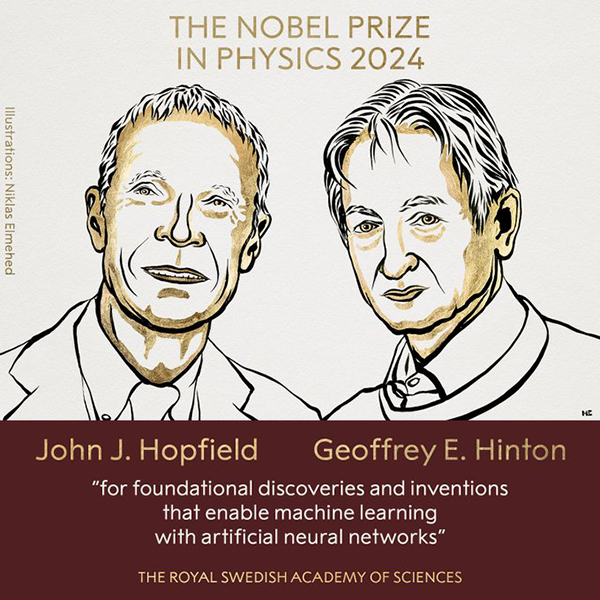
Scientists Geoffrey Hinton, John Hopfield win Nobel Prize in Physics for work in machine learning
The Royal Swedish Academy of Sciences on Tuesday presented the Nobel Prize for Physics to two scientists Geoffrey Hinton and John Hopfield for their contribution to the field of machine learning.
" John Hopfield created an associative memory that can store and reconstruct images and other types of patterns in data. Geoffrey Hinton invented a method that can autonomously find properties in data, and so perform tasks such as identifying specific elements in pictures," read a statement issued by the award-giving body.
"When we talk about artificial intelligence, we often mean machine learning using artificial neural networks," read the statement.
This technology was originally inspired by the structure of the brain.
In an artificial neural network, the brain’s neurons are represented by nodes that have different values.
These nodes influence each other through connections that can be likened to synapses and which can be made stronger or weaker.
The network is trained, for example by developing stronger connections between nodes with simultaneously high values.
This year’s laureates have conducted important work with artificial neural networks from the 1980s onward.
Some interesting facts about John Hofield and Geoffrey Hinton
John Hopfield invented a network that uses a method for saving and recreating patterns. We can imagine the nodes as pixels.
The Hopfield network utilises physics that describes a material’s characteristics due to its atomic spin – a property that makes each atom a tiny magnet.
The network as a whole is described in a manner equivalent to the energy in the spin system found in physics, and is trained by finding values for the connections between the nodes so that the saved images have low energy.
When the Hopfield network is fed a distorted or incomplete image, it methodically works through the nodes and updates their values so the network’s energy falls.
The network thus works stepwise to find the saved image that is most like the imperfect one it was fed with.
Geoffrey Hinton used the Hopfield network as the foundation for a new network that uses a different method: the Boltzmann machine.
This can learn to recognise characteristic elements in a given type of data. Hinton used tools from statistical physics, the science of systems built from many similar components.
The machine is trained by feeding it examples that are very likely to arise when the machine is run.
The Boltzmann machine can be used to classify images or create new examples of the type of pattern on which it was trained.
Hinton has built upon this work, helping initiate the current explosive development of machine learning.
Prize amount: 11 million Swedish kronor ((USD 1 million) to be shared equally between the laureates.
Support Our Journalism
We cannot do without you.. your contribution supports unbiased journalism
IBNS is not driven by any ism- not wokeism, not racism, not skewed secularism, not hyper right-wing or left liberal ideals, nor by any hardline religious beliefs or hyper nationalism. We want to serve you good old objective news, as they are. We do not judge or preach. We let people decide for themselves. We only try to present factual and well-sourced news.
Support objective journalism for a small contribution.


