


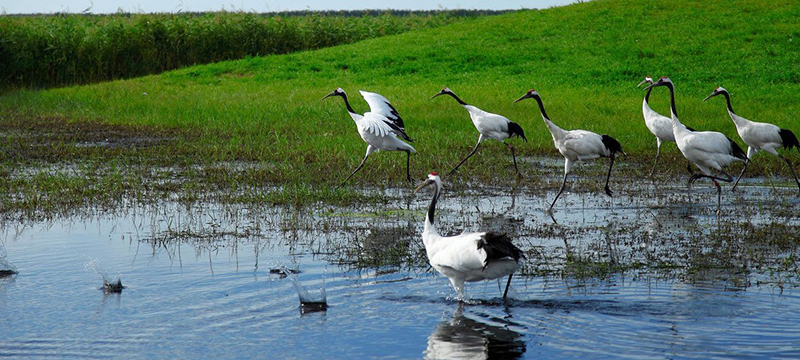
 Wetland
Revive and restore wetlands, home to 40 per cent of all biodiversity
New York: Although coastal and freshwater wetlands – such as swamps, mangroves and marshes - contain 40 per cent of all plant and animal species, many are polluted or degraded due to climate change and human development.
On World Wetlands Day, observed this Thursday, the United Nations is calling for urgent action to revive and restore these ecosystems, which are disappearing three times faster than forests.
Wetlands cover roughly six per cent of the Earth’s land surface and are vital for human health, food supply, tourism and jobs.
Fighting climate change
More than a billion people worldwide depend on them for their livelihoods, while their shallow waters and abundant plant life support everything from insects to ducks to moose.
Wetlands also play a crucial role in both achieving sustainable development and in the fight against climate change.
They provide essential ecosystem services such as water regulation, reducing the impact of flooding, for example.
Peatlands, a particular type of vegetated wetland, store twice as much carbon as forests.
Loss accelerating
However, over the past 200 years, wetlands have been drained to make way for farmland or infrastructure development, according to the UN Environment Programme (UNEP).
Roughly 35 per cent of all wetlands globally disappeared between 1970 and 2015, and the rate of loss has been accelerating since the year 2000.
Depending on the amount of climate-related sea level rise, some 20 to 90 per cent of current coastal wetlands could be gone by the end of the century, UNEP warned.
Wetlands have also suffered more biodiversity loss than other land and marine ecosystems.
Invest in restoration
Leticia Carvalho, head of the agency’s Marine and Freshwater Branch, urged governments to end policies and subsidies that incentivize deforestation and wetlands degradation, and urgently focus on restoration.
“At the same time, we must guide and drive investments to protect priority ecosystems, such as peatlands, and encourage the private sector to commit to deforestation and peatland-drainage-free supply chains,” she added.
Landmark protection deal
Recently, governments have been stepping up efforts to protect wetlands.
At the UN Biodiversity Conference in December, countries agreed a landmark deal to protect a third of the planet’s lands, coastal areas and inland waters by 2030.
Action to restore wetlands is gathering momentum around the world. For example, China is developing the “sponge cities” concept, in the face of rapid urbanization and intensified climate hazards, including flooding.
Initiatives include “green” rooves, constructed wetlands and pavements that capture, slow down and filter storm water.
Financing for nature
In a report published last year, UNEP stressed the need to increase investments in nature-based solutions to meet global climate, biodiversity and land degradation goals.
Currently, $154 billion is spent per year but this figure should more than double to $384 billion by 2025.
“We’re running out of chances to protect the services provided by wetlands that societies depend on for a sustainable future,” said Ms. Carvalho.
“We must ramp up international solidarity, capacity-building and funding without further delay.”
Support Our Journalism
We cannot do without you.. your contribution supports unbiased journalism
IBNS is not driven by any ism- not wokeism, not racism, not skewed secularism, not hyper right-wing or left liberal ideals, nor by any hardline religious beliefs or hyper nationalism. We want to serve you good old objective news, as they are. We do not judge or preach. We let people decide for themselves. We only try to present factual and well-sourced news.
Support objective journalism for a small contribution.


