


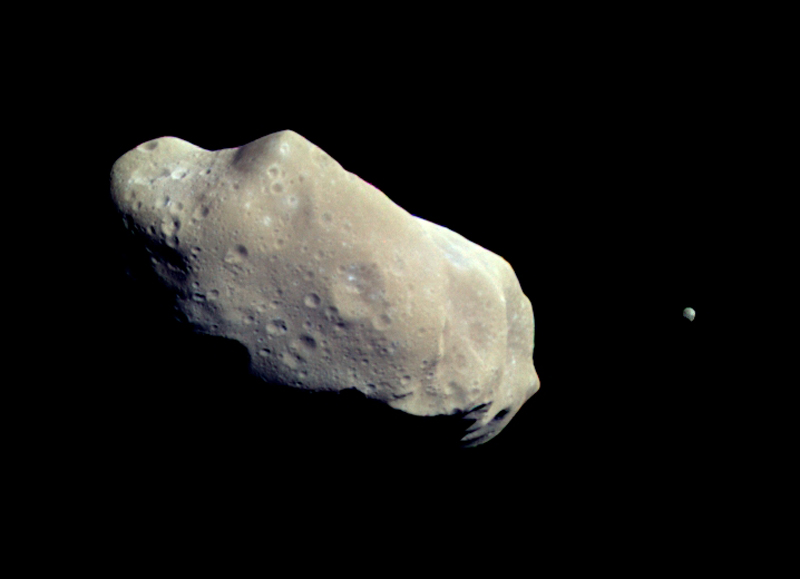
'Potentially hazardous' asteroid set to fly past Earth on Jul 24 : B M Birla Science Centre
Hyderabad, Jul 18 (UNI) Travelling at a staggering speed of 13.5 kilometres per second or 48,000 kilometres per hour, an asteroid will come within just 0.034 astronomical units (Astronomical unit is the distance between the Earth and Sun) of the earth on July 24, B M Birla Science Centre Director Dr B G Sidharth said.
In a statement here on Saturday, Dr Sidharth said, a gigantic and 'potentially hazardous' asteroid believed to be bigger than the London Eye is set to fly past the Earth on July 24, NASA has warned.
London Eye, the famous UK landmark is 443 feet high, and the asteroid is larger than the latter by as much as 50 per cent.
This space rock named as Asteroid 2020ND, measuring 170 metres will make a close approach to our planet. Travelling at a staggering speed of 13.5 kilometres per second or 48,000 kilometres per hour, the asteroid will come within just 0.034 astronomical units (AU) of the earth on next Friday.
An astronomical unit is equal to about 150 million kilometres or roughly the distance from the Earth to the Sun.
"Potentially Hazardous Asteroids (PHAs) are currently defined based on parameters that measure the asteroid's potential to make threatening close approaches to the Earth. Specifically, all asteroids with a minimum orbit intersection distance (MOID) of 0.05 au or less and an absolute magnitude (H) of 22.0 or less are considered PHAs," the statement added.
Giving more information, NASA on its Jet Propulsion Laboratory (JPL) website said: "NEOs are comets and asteroids that have been nudged by the gravitational attraction of nearby planets into orbits that allow them to enter the Earth's neighbourhood.
"The scientific interest in comets and asteroids is due largely to their status as the relatively unchanged remnant debris from the solar system formation process some 4.6 billion years ago."
The NASA added, "The giant outer planets (Jupiter, Saturn, Uranus, and Neptune) formed from an agglomeration of billions of comets and the leftover bits and pieces from this formation process are the comets we see today.
"Likewise, today's asteroids are the bits and pieces leftover from the initial agglomeration of the inner planets that include Mercury, Venus, Earth, and Mars.''
Support Our Journalism
We cannot do without you.. your contribution supports unbiased journalism
IBNS is not driven by any ism- not wokeism, not racism, not skewed secularism, not hyper right-wing or left liberal ideals, nor by any hardline religious beliefs or hyper nationalism. We want to serve you good old objective news, as they are. We do not judge or preach. We let people decide for themselves. We only try to present factual and well-sourced news.
Support objective journalism for a small contribution.


