


Pluto's 'Hulk-like' Moon Charon: A possible ancient ocean?
Images from NASA’s New Horizons mission suggest that Pluto’s moon Charon once had a subsurface ocean that has long since frozen and expanded, pushing outward and causing the moon’s surface to stretch and fracture on a massive scale.
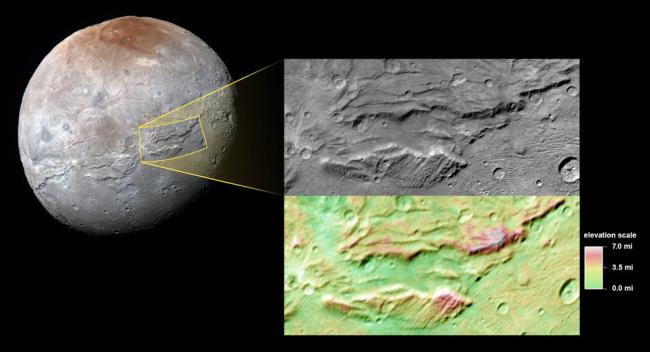
The side of Pluto’s largest moon viewed by NASA’s passing New Horizons spacecraft in July 2015 is characterized by a system of “pull apart” tectonic faults, which are expressed as ridges, scarps and valleys—the latter sometimes reaching more than 4 miles (6.5 kilometers) deep. Charon’s tectonic landscape shows that, somehow, the moon expanded in its past, and – like Bruce Banner tearing his shirt as he becomes the Incredible Hulk – Charon’s surface fractured as it stretched.
The outer layer of Charon is primarily water ice. This layer was kept warm when Charon was young by heat provided by the decay of radioactive elements, as well as Charon’s own internal heat of formation. Scientists say Charon could have been warm enough to cause the water ice to melt deep down, creating a subsurface ocean. But as Charon cooled over time, this ocean would have frozen and expanded (as happens when water freezes), lifting the outermost layers of the moon and producing the massive chasms we see today.
The top portion of this image shows part of the feature informally named Serenity Chasma, part of a vast equatorial belt of chasms on Charon. In fact, this system of chasms is one of the longest seen anywhere in the solar system, running at least 1,100 miles (about 1,800 kilometers) long and reaching 4.5 miles (7.5 kilometers) deep. By comparison, the Grand Canyon is 277 miles (446 kilometers) long and just over a mile (1.6 kilometers) deep.
The lower portion of the image shows color-coded topography of the same scene. Measurements of the shape of this feature tell scientists that Charon’s water ice layer may have been at least partially liquid in its early history, and has since refrozen.
This image was obtained by the Long-Range Reconnaissance Imager (LORRI) on New Horizons. North is up; illumination is from the top-left of the image. The image resolution is about 1,290 feet (394 meters) per pixel. The image measures 240 miles (386 kilometers) long and 110 miles (175 kilometers) wide. It was obtained at a range of approximately 48,900 miles (78,700 kilometers) from Charon, about an hour and 40 minutes before New Horizons’ closest approach to Charon on July 14, 2015.
Image Credits: NASA/JHUAPL/SwRI
Support Our Journalism
We cannot do without you.. your contribution supports unbiased journalism
IBNS is not driven by any ism- not wokeism, not racism, not skewed secularism, not hyper right-wing or left liberal ideals, nor by any hardline religious beliefs or hyper nationalism. We want to serve you good old objective news, as they are. We do not judge or preach. We let people decide for themselves. We only try to present factual and well-sourced news.
Support objective journalism for a small contribution.


