


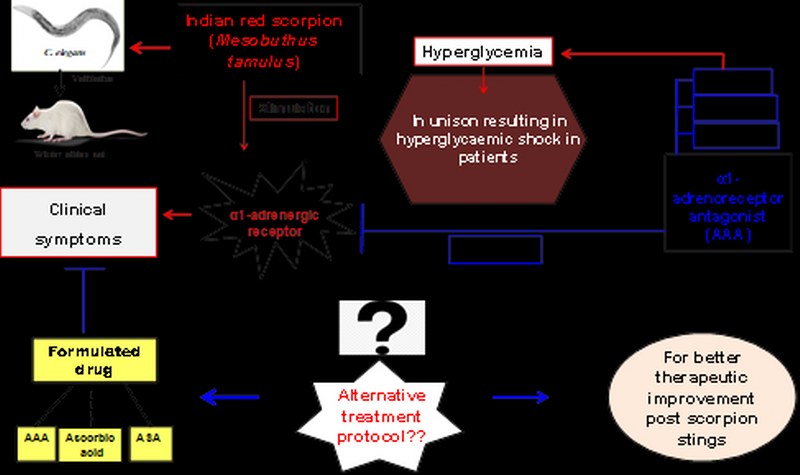
Novel therapeutic formulation developed for improved treatment of Indian red scorpion sting
New Delhi: A breakthrough therapeutic drug formulation (TDF) has been developed to combat the toxicity caused by Indian red scorpion venom, offering a significant advancement in the clinical treatment of scorpion sting patients, the Ministry of Science and Technology said on Wednesday.
This new formulation combines low doses of commercial equine anti-scorpion antivenom (ASA), α1- adrenoreceptor agonist (AAAs), and vitamin C.
Scorpion envenomation, particularly from the highly dangerous Indian red scorpion, poses a serious threat in many parts of the world.
The conventional treatment using ASA and AAAs has limitations, making this new TDF a potential game-changer.
Developed by a team of scientists from the Institute of Advanced Study in Science and Technology (IASST) and scholars from Tezpur University NIELIT, Guwahati, the drug has shown remarkable efficacy in pre-clinical trials.
The study team included Prof. Ashis Mukherjee, Director, Dr. M. R. Khan, Associate Professor, and Dr. Aparup Patra, IPDF from IASST, Dr. Bhabana Das, and Upasana Pujari from Tezpur University, and Dr. S. Mahanta, from NIELIT.
The research, published in the journal Toxins, marks a significant step forward in scorpion sting treatment, with the potential to save countless lives globally.
Support Our Journalism
We cannot do without you.. your contribution supports unbiased journalism
IBNS is not driven by any ism- not wokeism, not racism, not skewed secularism, not hyper right-wing or left liberal ideals, nor by any hardline religious beliefs or hyper nationalism. We want to serve you good old objective news, as they are. We do not judge or preach. We let people decide for themselves. We only try to present factual and well-sourced news.
Support objective journalism for a small contribution.


