


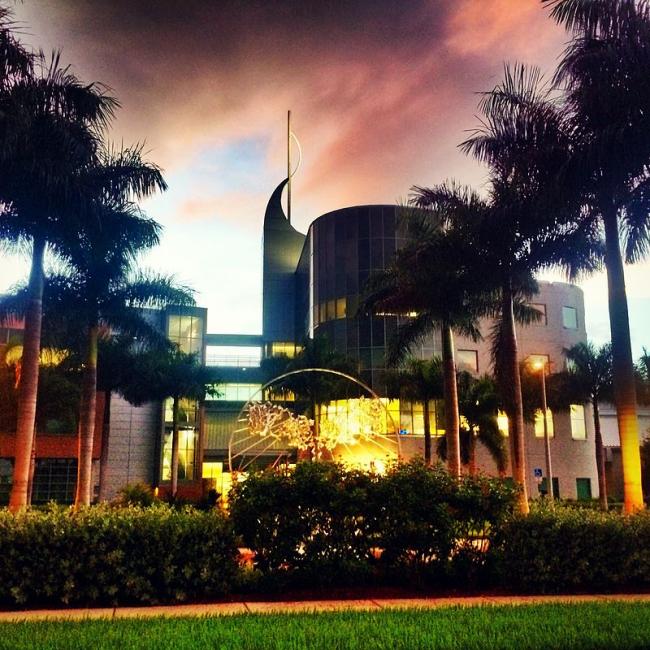
New equipment at Scripps Florida will advance drug discovery
The grant will fund the purchase of a 600 Mhz NMR machine, which will help researchers develop drugs and understand how those drugs act in the body.
The TSRI’s Florida campus currently houses three NMR machines, but as the scientists have continued to focus on translational research—studies that aim to “translate” laboratory findings into potential treatments for disease—those machines are constantly in use.
“We were basically maxed out on instrument time,” said TSRI Associate Professor Douglas Kojetin, project leader on the new grant. “All of our instruments were all near 100 percent usage.”
The researchers use these machines throughout the drug development process. NMR applies a strong magnetic field to sample, which interacts with the individual atoms in a molecule, allowing scientists to discern that molecule’s structure.
Chemists at TSRI regularly use the two lower-field NMRs the institute currently owns, which apply a magnetic field around 400MHz, to confirm the structures of molecules they have either synthesized in the lab or isolated from natural sources.
TSRI also has one 700mhz NMR, which Kojetin and his colleagues use to understand how small molecules interact with other molecules in the body, including proteins, receptors and RNA.
The new 600mhz NMR will be able to support all types of research, with many of the capabilities of both the higher and lower field machines.
For example, Kojetin’s lab studies how drugs for type II diabetes interact with their receptors. While effective at treating diabetes, these drugs also have a wide range of undesirable side effects. Using NMR, Kojetin’s group is working to gain a better understanding of how these drug molecules cause both their positive and negative effects, with the intent of designing a molecule that could treat the disease while minimizing a patient’s side effects.
Kojetin added that the new equipment will not only expedite more than 20 NIH-funded projects currently in progress at TSRI, but it will help generate new data that will lead to more grant funding and more discoveries.
“The addition of this instrument will place us within the top NMR facilities in South Florida,” said Kojetin.
Image: Wikimedia Commons
Support Our Journalism
We cannot do without you.. your contribution supports unbiased journalism
IBNS is not driven by any ism- not wokeism, not racism, not skewed secularism, not hyper right-wing or left liberal ideals, nor by any hardline religious beliefs or hyper nationalism. We want to serve you good old objective news, as they are. We do not judge or preach. We let people decide for themselves. We only try to present factual and well-sourced news.
Support objective journalism for a small contribution.


