


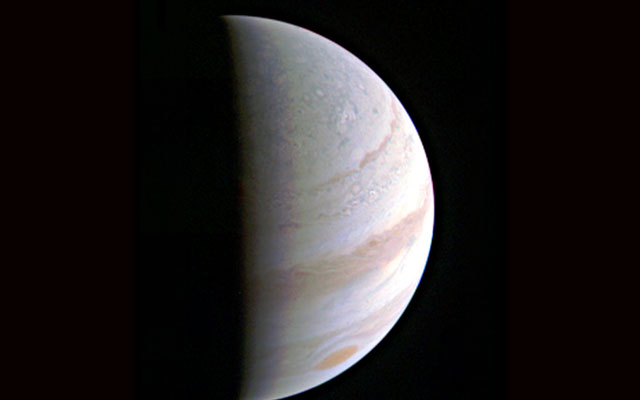
NASA's Juno successfully completes Jupiter flyby
The time of closest approach with the gas-giant world was 6:44 a.m. PDT (9:44 a.m. EDT, 13:44 UTC) when Juno passed about 2,600 miles (4,200 kilometers) above Jupiter's swirling clouds.
At the time, Juno was traveling at 130,000 mph (208,000 kilometers per hour) with respect to the planet.
This flyby was the closest Juno will get to Jupiter during its prime mission.
"Early post-flyby telemetry indicates that everything worked as planned and Juno is firing on all cylinders," said Rick Nybakken, Juno project manager at NASA's Jet Propulsion Laboratory in Pasadena, California.
There are 35 more close flybys of Jupiter planned during Juno's mission (scheduled to end in February 2018).
The Aug 27 flyby was the first time Juno had its entire suite of science instruments activated and looking at the giant planet as the spacecraft zoomed past.
"We are getting some intriguing early data returns as we speak," said Scott Bolton, principal investigator of Juno from the Southwest Research Institute in San Antonio.
"It will take days for all the science data collected during the flyby to be downlinked and even more to begin to comprehend what Juno and Jupiter are trying to tell us."
While results from the spacecraft's suite of instruments will be released down the road, a handful of images from Juno's visible light imager -- JunoCam -- are expected to be released the next couple of weeks. Those images will include the highest-resolution views of the Jovian atmosphere and the first glimpse of Jupiter's north and south poles.
"We are in an orbit nobody has ever been in before, and these images give us a whole new perspective on this gas-giant world," said Bolton.
The Juno spacecraft launched on Aug. 5, 2011, from Cape Canaveral, Florida, and arrived at Jupiter on July 4, 2016.
JPL manages the Juno mission for the principal investigator, Scott Bolton, of Southwest Research Institute in San Antonio.
Juno is part of NASA's New Frontiers Program, which is managed at NASA's Marshall Space Flight Center in Huntsville, Alabama, for NASA's Science Mission Directorate. Lockheed Martin Space Systems, Denver, built the spacecraft. Caltech in Pasadena, California, manages JPL for NASA.
Credits: NASA/JPL-Caltech/SwRI/MSSS
Support Our Journalism
We cannot do without you.. your contribution supports unbiased journalism
IBNS is not driven by any ism- not wokeism, not racism, not skewed secularism, not hyper right-wing or left liberal ideals, nor by any hardline religious beliefs or hyper nationalism. We want to serve you good old objective news, as they are. We do not judge or preach. We let people decide for themselves. We only try to present factual and well-sourced news.
Support objective journalism for a small contribution.


