


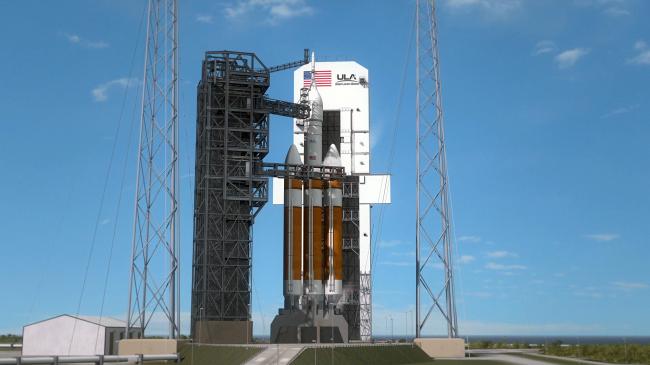
NASA's deep-space spacecraft Orion ready for test flight
It has been learnt that Orion is the first vehicle made to take astronauts to deep space destinations, such as the asteroids or Mars. Orion will serve as the exploration vehicle that will carry the crew to space, provide emergency abort capability, sustain the crew during the space travel, and provide safe re-entry from deep space return velocities, NASA said on its website.
The spacecraft is expected to be launched aboard a United Launch Alliance Delta IV heavy rocket from launch complex 37 at Cape Canaveral Air Force Station and will complete a 4.5-hour, two-orbit test flight.
During the 4.5-hour flight, called Exploration Flight Test-1, Orion will travel farther than any crewed spacecraft has gone in more than 40 years, before returning to Earth at speeds near 20,000 mph and generating temperatures up to 4,000 degrees Fahrenheit.
Designed and built by the Lockheed Martin Space Systems Co. (LMSS), the fully-assembled Orion stands 72 feet tall.
The spacecraft will travel around 3,600 miles into space and return to Earth at a speed of more than 20,000 mph intended to ensure the spacecraft’s critical systems are ready for the challenges of deep space missions.
The assembled Orion crew module, service module, launch abort system and adapter will reside in Kennedy’s Launch Abort System Facility until its scheduled rollout to the launch pad, set for Nov. 10.
Support Our Journalism
We cannot do without you.. your contribution supports unbiased journalism
IBNS is not driven by any ism- not wokeism, not racism, not skewed secularism, not hyper right-wing or left liberal ideals, nor by any hardline religious beliefs or hyper nationalism. We want to serve you good old objective news, as they are. We do not judge or preach. We let people decide for themselves. We only try to present factual and well-sourced news.
Support objective journalism for a small contribution.


