


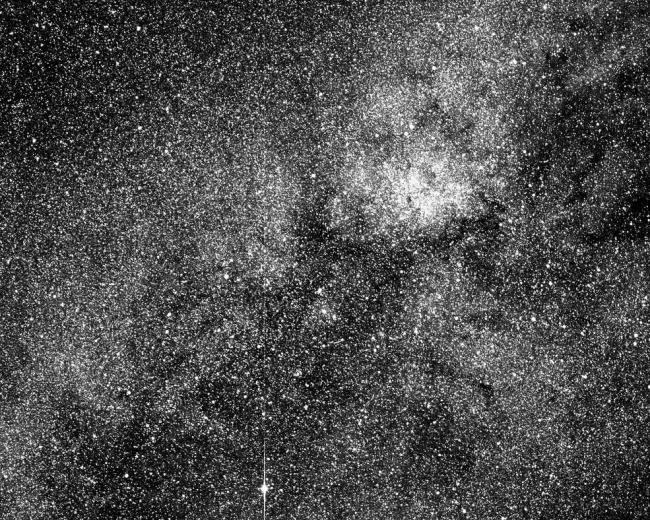
NASA’s new planet hunter snaps initial test image, swings by Moon toward final orbit
Washington, May 19 (IBNS): NASA’s next planet hunter, the Transiting Exoplanet Survey Satellite (TESS), is one step closer to searching for new worlds after successfully completing a lunar flyby on May 17.
The spacecraft passed about 5,000 miles from the Moon, which provided a gravity assist that helped TESS sail toward its final working orbit, read a NASA website.
As part of camera commissioning, the science team snapped a two-second test exposure using one of the four TESS cameras. The image, centered on the southern constellation Centaurus, reveals more than 200,000 stars.
The edge of the Coalsack Nebula is in the right upper corner and the bright star Beta Centauri is visible at the lower left edge.
TESS is expected to cover more than 400 times as much sky as shown in this image with its four cameras during its initial two-year search for exoplanets.
A science-quality image, also referred to as a “first light” image, is expected to be released in June.
TESS will undergo one final thruster burn on May 30 to enter its science orbit around Earth.
This highly elliptical orbit will maximize the amount of sky the spacecraft can image, allowing it to continuously monitor large swaths of the sky.
TESS is expected to begin science operations in mid-June after reaching this orbit and completing camera calibrations.
Launched from Cape Canaveral Air Force Station in Florida on April 18, TESS is the next step in NASA’s search for planets outside our solar system, known as exoplanets.
The mission will observe nearly the entire sky to monitor nearby, bright stars in search of transits — periodic dips in a star’s brightness caused by a planet passing in front of the star.
TESS is expected to find thousands of exoplanets. NASA’s upcoming James Webb Space Telescope, scheduled for launch in 2020, will provide important follow-up observations of some of the most promising TESS-discovered exoplanets, allowing scientists to study their atmospheres.
TESS is a NASA Astrophysics Explorer mission led and operated by MIT in Cambridge, Massachusetts, and managed by NASA’s Goddard Space Flight Center in Greenbelt, Maryland. Dr. George Ricker of MIT’s Kavli Institute for Astrophysics and Space Research serves as principal investigator for the mission. Additional partners include Orbital ATK, based in Dulles, Virginia; NASA’s Ames Research Center in California’s Silicon Valley; the Harvard-Smithsonian Center for Astrophysics in Cambridge, Massachusetts; and the Space Telescope Science Institute in Baltimore.
The TESS science instruments were jointly developed by MIT’s Kavli Institute for Astrophysics and Space Research and MIT’s Lincoln Laboratory. More than a dozen universities, research institutes and observatories worldwide are participants in the mission.
Support Our Journalism
We cannot do without you.. your contribution supports unbiased journalism
IBNS is not driven by any ism- not wokeism, not racism, not skewed secularism, not hyper right-wing or left liberal ideals, nor by any hardline religious beliefs or hyper nationalism. We want to serve you good old objective news, as they are. We do not judge or preach. We let people decide for themselves. We only try to present factual and well-sourced news.
Support objective journalism for a small contribution.


