


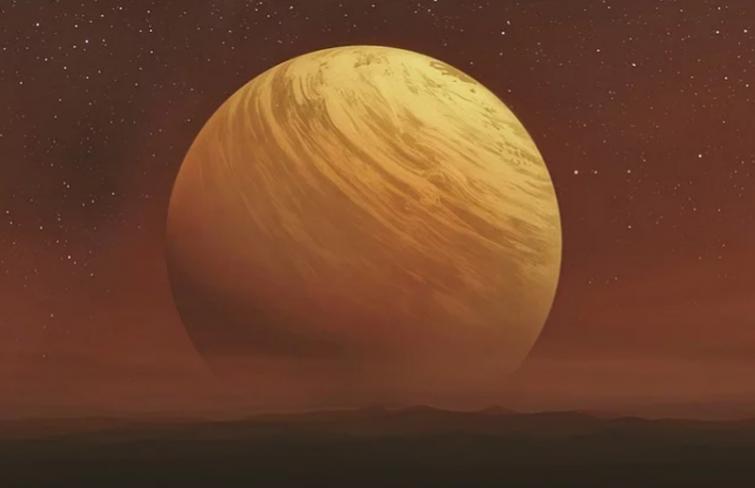
NASA completes 1st global geologic map of Saturn's Moon
Los Angeles/Xinhua/UNI: NASA scientists have completed the first map showing the global geology of Saturn's largest moon Titan, NASA's Jet Propulsion Laboratory (JPL) has said in a release.
The map fully reveals a dynamic world of dunes, lakes, plains, craters and other terrains, said the JPL.
"Titan is the only planetary body in the solar system other than Earth known to have stable liquid on its surface. But instead of water raining down from clouds and filling lakes and seas as on Earth, on Titan what rains down is methane and ethane ... that behave as liquids in Titan's frigid climate," it said on Monday.
"Titan has an active methane-based hydrologic cycle that has shaped a complex geologic landscape, making its surface one of most geologically diverse in the solar system," Rosaly Lopes, a planetary geologist at JPL and lead author of new research used to develop the map, was quoted as saying by the JPL.
"Despite the different materials, temperatures and gravity fields between Earth and Titan, many surface features are similar between the two worlds and can be interpreted as being products of the same geologic processes," she said.
According to the release, Lopes and her team worked with fellow planetary geologist David Williams of the School of Earth and Space Exploration at Arizona State University in Tempe. Their findings, which include the relative age of Titan's geologic terrains, were recently published in the journal Nature Astronomy.
"Lopes' team used data from NASA's Cassini mission, which operated between 2004 and 2017 and did more than 120 flybys of the Mercury-size moon. Specifically, they used data from Cassini's radar imager to penetrate Titan's opaque atmosphere of nitrogen and methane," said the JPL.
"In addition, the team used data from Cassini's visible and infrared instruments, which were able to capture some of Titan's larger geologic features through the methane haze," it said.
"This study is an example of using combined datasets and instruments," Lopes said.
"Although we did not have global coverage with synthetic aperture radar (SAR), we used data from other instruments and other modes from radar to correlate characteristics of the different terrain units so we could infer what the terrains are even in areas where we don't have SAR coverage," she said.
Support Our Journalism
We cannot do without you.. your contribution supports unbiased journalism
IBNS is not driven by any ism- not wokeism, not racism, not skewed secularism, not hyper right-wing or left liberal ideals, nor by any hardline religious beliefs or hyper nationalism. We want to serve you good old objective news, as they are. We do not judge or preach. We let people decide for themselves. We only try to present factual and well-sourced news.
Support objective journalism for a small contribution.


