


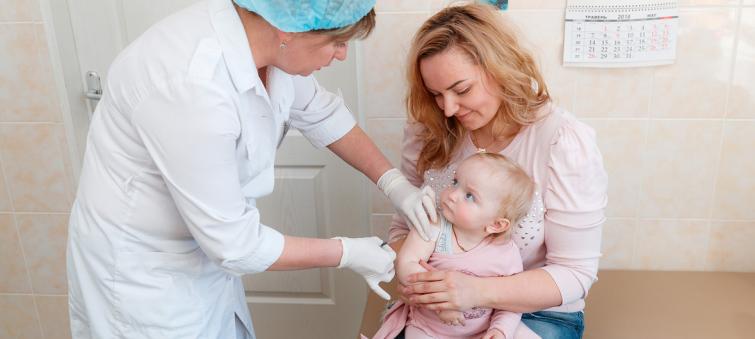
Measles cases nearly doubled in a year, UN health agency projects
New York, Feb 15 (IBNS): A projected near-doubling of measles infections has been identified amid rising severe and protracted outbreaks all over the planet, in poor and rich countries alike, the World Health Organization (WHO) said on Thursday.
The appeal to Member States to close gaps in vaccine coverage follows the previously announced news that an estimated 110,000 people died from the highly infectious but easily preventable disease in 2017.
“Measles is not going anywhere…It’s everyone’s responsibility,” said Dr. Katherine O’Brien, Director of Immunization, Vaccines and Biologicals at WHO. “For one person infected, up to nine or 10 people could catch the virus.”
In addition to being potentially fatal, measles symptoms include rashes, blindness and inflammation of the brain. The virus can be transmitted extremely easily, by coughing and sneezing, and it can also survive for hours in a droplet of water.
It knows no “geographical or political borders”, Dr. O’Brien said, noting nonetheless that since the year 2000, deaths from measles have fallen by over 80 per cent “probably saving around 21 million lives” in that period.
Disease burden in 2018 almost double previous 12-month tally
The WHO alert follows its announcement that as of mid-January this year, it had seen 229,068 reported cases of measles during 2018, in 183 Member States, which have until April to file data on the previous year’s disease burden.
This is almost double the 115,117 cases reported at the same point last year, and WHO’s concern is based on the fact that the final number of infections rose to 173,330.
“Due to reporting delays and outbreaks late in 2018, we expect that these numbers will increase, as they have done in previous years,” the agency said in a statement.
Measles infections ‘increased in all regions’
By region in 2018, Africa saw 33,879 measles infections; of these, 4,391 were from Madagascar alone, where 922 deaths have been reported in an ongoing outbreak that began last October.
The Americas recorded nearly 17,000 cases of measles in 2018, the Eastern Mediterranean, just under 22,000. In Europe, there were 82,596 infections in 47 of 53 countries, ahead of South-East Asia (73,133) and the Western Pacific (23,607).
To prevent outbreaks and eliminate measles, WHO urges countries to sustain high immunization coverage with two doses of measles vaccine, a regimen which has been administered to “billions” of children, Dr. O’Brien told journalists in Geneva.
“We’re backsliding on the progress that has been made, not because we don’t have the tools, but because we’re not vaccinating,” she insisted.
Measles jab myth debunked
There is no association between autism and the measles jab; that myth has been debunked, Dr. O’Brien said, noting that the study that started the falsehood, was based on erroneous data.
Nonetheless, in recent years vaccine coverage has stalled, at 85 per cent. This is far short of the 95 per cent needed to prevent outbreaks and leaves many people susceptible to the disease. Second-dose coverage stands at 67 per cent.
Countries should also identify and address all communities that are under-immunized, advised Dr. Katrina Kretsinger, Medical Officer in the Expanded Programme on Immunization at WHO.
“Some populations are more at risk than others” she said. “Children, migrants, refugees and poor populations.”
Although WHO is working in affected regions with ministries of health it won’t commit to a compulsory vaccination recommendation.
“It’s up to the countries to implement vaccination programmes,” Dr. Kretsinger suggested. “Some have made it mandatory for children to be vaccinated in order to attend school.”
Before the introduction of the measles vaccine in 1963, outbreaks and epidemics occurred every two to three years, causing an estimated 2.6 million deaths every year.
Image Credit: UNICEF/UN0201055/Krepkih
Support Our Journalism
We cannot do without you.. your contribution supports unbiased journalism
IBNS is not driven by any ism- not wokeism, not racism, not skewed secularism, not hyper right-wing or left liberal ideals, nor by any hardline religious beliefs or hyper nationalism. We want to serve you good old objective news, as they are. We do not judge or preach. We let people decide for themselves. We only try to present factual and well-sourced news.
Support objective journalism for a small contribution.


