


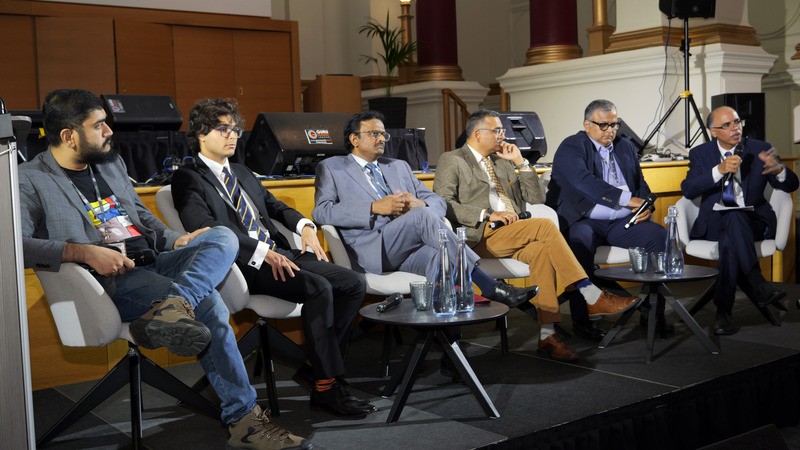
 AI In Healthcare
Indi Setu London: AI in Healthcare Needs Trust, Training, and Proof, Say Global Experts
London/IBNS: Artificial Intelligence may be transforming healthcare—from reading scans to assisting in surgery—but its success depends on assurance, adoption, and education, agreed experts at the Indi Setu Thought Leadership Summit in London last month.
While AI now powers diagnostics, drug discovery, and even robotic precision in the operating room, its integration into mainstream clinical workflows remains uneven.
Questions of accountability, algorithmic bias, and data privacy continue to shape how hospitals and policymakers approach the technology. As governments and health systems race to adopt AI safely, experts stressed that “trust” — not just “tech” — will define the next frontier of healthcare innovation.
The high-powered panel on “Reimagining Healthcare Management Through AI” was moderated by Dr. Subramaniasivam Natarajan, Director of SV Healthcare Solutions Ltd., London.
It featured Dr. Tapabrata (Rohan) Chakraborty, Theme Lead in Frontier AI Assurance at the Turing-Roche Partnership (University of Oxford and UCL); Dr. Sivakumar Manickam, Consultant Radiologist at Darlington Memorial and Bishop Auckland General Hospitals, UK; Dr. Joydeep Grover, President-elect of BAPIO and Medical Director (Safety) at North Bristol NHS Trust; Debraj Dutta, Intelligent Automation Leader at EY UK; and Raghav Khanna, postgraduate researcher at King’s College London.
“From theory to trust”
Opening the discussion, Dr. Natarajan called for moving beyond the hype cycle toward practical deployment.
“We’ve been talking about AI for years, but adoption is still a work in progress,” he said. “The real question is, how do we make people trust and use it meaningfully within existing healthcare and insurance systems?”
AI assurance: the new frontier
Dr. Tapabrata (Rohan) Chakraborty underlined the global shift from building smarter models to proving their clinical reliability.
“We’re moving from focusing only on how AI systems work to how reliable and valid their decisions are,” he explained. “AI outputs must align with established medical concepts and come with measurable guarantees of performance.”
He stressed that the future of AI in healthcare lies in assurance frameworks, systems that certify trustworthiness before clinical use.
Radiology today, surgery tomorrow
Dr. Sivakumar Manickam noted that radiology currently dominates AI-driven healthcare but said the landscape is rapidly expanding.
“About 80% of healthcare AI today is in radiology,” he said. “But that’s changing fast. We’re seeing integration into surgery, oncology, and molecular medicine. It’s no longer just about robotic surgery—it’s about precision and prediction.”
AI literacy in classrooms
For the next generation of doctors and researchers, AI education is the new challenge, said Raghav Khanna of King’s College London.
“Students must learn to use AI tools intelligently and not depend on them blindly,” he said. “AI can help you brainstorm or explore topics, but real learning still needs curiosity and critical thinking.”
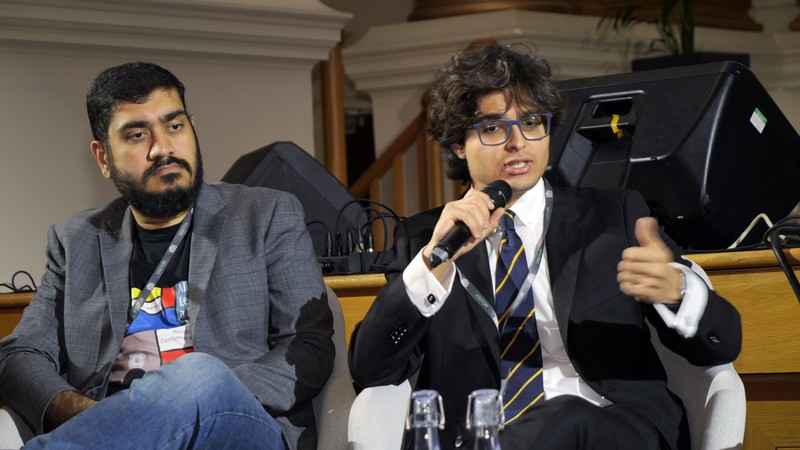 Experts in healthcare discuss the evolving role of artificial intelligence at the summit. Photo: Organisers
Khanna urged universities to integrate AI literacy without sacrificing core scientific training.
“The balance lies in teaching students how to question, not just how to query,” he added.
The human element remains central
Summing up, Dr. Natarajan reminded the audience that the power of AI depends on human intent.
“AI is not replacing doctors, it’s empowering them,” he said. “But for that to happen, we must focus equally on assurance, adoption, and education.”
Support Our Journalism
We cannot do without you.. your contribution supports unbiased journalism
IBNS is not driven by any ism- not wokeism, not racism, not skewed secularism, not hyper right-wing or left liberal ideals, nor by any hardline religious beliefs or hyper nationalism. We want to serve you good old objective news, as they are. We do not judge or preach. We let people decide for themselves. We only try to present factual and well-sourced news.
Support objective journalism for a small contribution.


