


 IIT
IIT
IIT Guwahati scientists develop free-space optical communication system for one-to-one line-of-sight communication
Guwahati/IBNS: A research team led by IIT Guwahati faculty, Dr. Bosanta Ranjan Boruah, Department of Physics, IIT Guwahati, and Dr. Santanu Konwar, presently an Assistant Professor at the Department of Physics, Abhayapuri College, Assam, has developed a novel free-space optical communication system for information transfer.
In free-space communication, data in the form of voice, text or image is transmitted using light wirelessly rather than through optical fibres and it represents the next generation of communications technology.
The results of this pathbreaking work has recently been published in "Communications Physics (https://www.nature.com/articles/s42005-020-00468-1)" a highly reputed journal belonging to Nature Publishing Group.
The past couple of decades have seen phenomenal developments in free-space communication. Most free-space communication systems developed so far all over the world use a type of light beam called the vortex beam to encode the data.
The problem in the use of a vortex beam is that it can be distorted by turbulence that may occur in the medium of propagation. In effect, data transmitted wirelessly using light/laser beams, can become corrupted when transmitted through atmospheric turbulence such as wind.
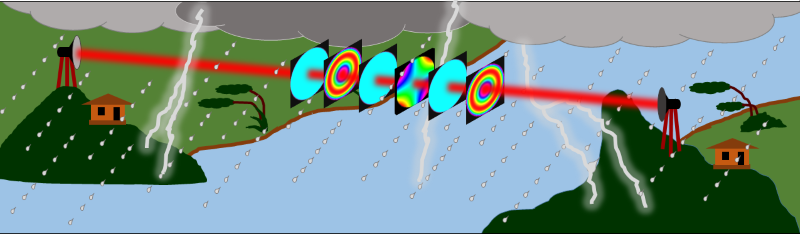
To overcome this problem, the IIT Guwahati researchers have, for the first time, used orthogonal spatial light modes called Zernike modes to encode the data and to transmit the same robustly in the form of the phase profile of a laser beam.
Explaining the technicality of the research, Dr. Bosanta Ranjan Boruah, Department of Physics, IIT Guwahati said, "In our work, the transmission station modulates the phase profile of a laser beam that carries the data, in terms of the strengths of a few Zernike modes. In the process we also enhance the information content per modulation cycle of the laser beam."
At the point of reception, the laser beam with encoded user information is sensed by a specially designed wavefront sensor that decodes the user information.
In this communication system, a unique mechanism has been implemented that can compensate for the effect of atmospheric turbulence, so that the user information can be transmitted even through turbulent atmosphere resulting in negligible error at the receiving station.
"In addition to eliminating errors in communication, our system is also insulated from hacking and interloping, because the receiver decodes the transmitted beam by measuring the phase and not the power of the light beam, with prior knowledge about the strength and types of Zernike modes used, which make it more secure than wired and other conventional wireless forms of communication," Dr. Santanu Konwar, presently an Assistant Professor at the Department of Physics, Abhayapuri College, Assam said.
Furthermore, the transmission is directed strictly towards the receiver, unlike other wireless forms of communication in which the information is transmitted in all directions, adding to the security of the communication.
The research team has demonstrated the distortion-free transmission of text messages and images over a distance of one kilometre even in the presence of turbulence such as during a stormy weather.
The communication system can thus be used for high speed and secured communication between two individuals located either inside a building or outside.
Support Our Journalism
We cannot do without you.. your contribution supports unbiased journalism
IBNS is not driven by any ism- not wokeism, not racism, not skewed secularism, not hyper right-wing or left liberal ideals, nor by any hardline religious beliefs or hyper nationalism. We want to serve you good old objective news, as they are. We do not judge or preach. We let people decide for themselves. We only try to present factual and well-sourced news.
Support objective journalism for a small contribution.


