


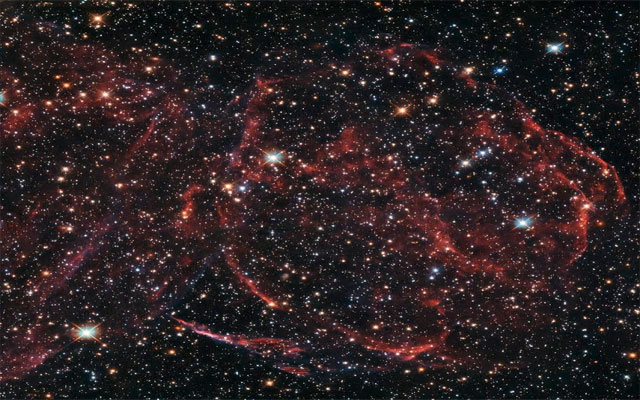
Hubble gazes at long-dead star
These rippling wisps of ionized gas, named DEM L316A, are located some 160,000 light-years away within one of the Milky Way’s closest galactic neighbors — the Large Magellanic Cloud (LMC).
The explosion that formed DEM L316A was an example of an especially energetic and bright variety of supernova, known as a Type Ia. Such supernova events are thought to occur when a white dwarf star steals more material than it can handle from a nearby companion, and becomes unbalanced. The result is a spectacular release of energy in the form of a bright, violent explosion, which ejects the star’s outer layers into the surrounding space at immense speeds. As this expelled gas travels through the interstellar material, it heats up and ionizes it, producing the faint glow that Hubble’s Wide Field Camera 3 has captured here, read the NASA website.
The LMC orbits the Milky Way as a satellite galaxy and is the fourth largest in our group of galaxies, the Local Group. DEM L316A is not the only supernova remnant in the LMC; Hubble came across another one in 2010 with SNR 0509, and in 2013 it snapped SNR 0519.
Image credit: ESA (European Space Agency)/Hubble & NASA, Y. Chu
Text credit: ESA
Support Our Journalism
We cannot do without you.. your contribution supports unbiased journalism
IBNS is not driven by any ism- not wokeism, not racism, not skewed secularism, not hyper right-wing or left liberal ideals, nor by any hardline religious beliefs or hyper nationalism. We want to serve you good old objective news, as they are. We do not judge or preach. We let people decide for themselves. We only try to present factual and well-sourced news.
Support objective journalism for a small contribution.


