


Groundwater preservation the key
Climate researcher Madhumita Sahoo works to identify solutions and approaches to manage groundwater resources to the advantage of people everywhere. SPAN writer Michael Gallant reports
For millions of people in India and beyond, drawing clean water from the ground is essential for survival, but climate change and pollution are threatening this vital resource. This is the problem that researcher Madhumita Sahoo has devoted her career to solving.
Sahoo earned her Ph.D. in 2017 from the Indian Institute of Technology (IIT) Kharagpur, where she studied how groundwater sustains lives and the problems that the resource can face. Particularly in dry areas and places where surface sources like rivers and streams are unusable, groundwater can be the alternate source people need for drinking, cooking, agriculture and industry. But careless management of this resource, as well as rapidly changing climate patterns, can lead to contamination or depletion and danger for those who rely on groundwater resources.
To help people continue to get the water they need, Sahoo relies on science, creativity and data. “My research on groundwater modeling deals with identifying potential areas for groundwater exploration, identifying areas that are vulnerable to contamination, finding alternative sources of data to fill in for missing information while modeling the subsurface environment,” she says. “Overall, I am trying to identify solutions and approaches to manage groundwater resources to the advantage of people.”
Specifically, Sahoo has developed her own technique for combining data from remote sensors, satellites, and even plants to monitor how much water flows into and out of underground water reserves. Called “regional groundwater modeling,” this type of analysis helps Sahoo look at groundwater issues in a broader context of geography, weather patterns, and climate change. It can also help communities plan effectively to avoid over-tapping precious groundwater reserves and polluting those reservoirs with dangerous contaminants.
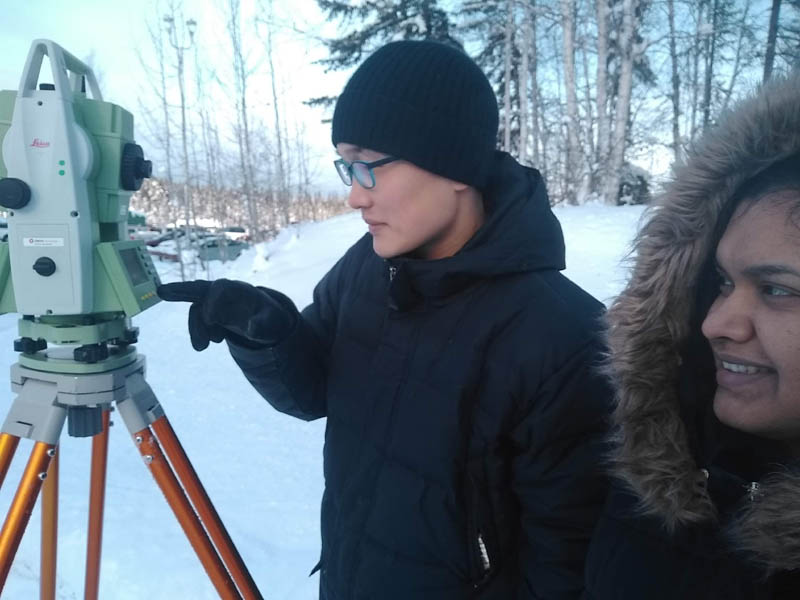
In 2019, Sahoo was selected for the Fulbright-Kalam Climate Fellowship, a programme sponsored by the US and Indian governments to build long-term capacity to address climate change related issues in India and the United States. She first learned about the fellowship from her professors at IIT Kharagpur and “wanted to study the impacts of climate change on water resources and observe the effects of rising temperature on groundwater quality,” she says. Before applying, she had been in regular correspondence with Debasmita Misra, a professor specialising in geoenvironmental engineering, soil and groundwater at the University of Alaska Fairbanks.
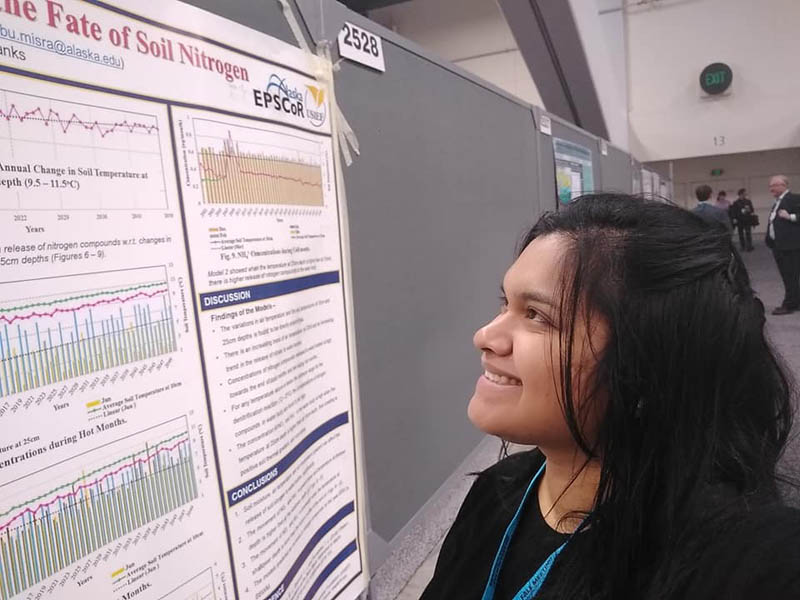
After winning the fellowship, Sahoo joined Misra in Alaska to begin their research partnership. “When I arrived, I got introduced to Professor Misra’s collaborators and learned how the soil properties have shown changes in their regions,” she says. “Apart from this, I joined the International Soil Modeling Consortium to learn more about the ongoing research related to my studies. The Fulbright-Kalam Fellowship provided an opportunity for me to interact with experts across the globe and get their support in my research.”
During her time in Alaska, Sahoo studied both how changing temperatures affected local soil and the implications for groundwater supply. And though the coronavirus pandemic disrupted her fieldwork, she was still able to continue many of her activities online. Among other topics, she studied the spread of perfluoroalkyl substances (PFAS), a troubling contaminant in the United States and elsewhere, and how the pollutant could be removed from well water to protect public safety.
Sahoo describes the fellowship as a “once-in-a-lifetime experience,” giving her the opportunity to work with experts and experience world-class research. “I found new confidence in myself and I am certain I will get more opportunities to work on this problem in the future.”
Support Our Journalism
We cannot do without you.. your contribution supports unbiased journalism
IBNS is not driven by any ism- not wokeism, not racism, not skewed secularism, not hyper right-wing or left liberal ideals, nor by any hardline religious beliefs or hyper nationalism. We want to serve you good old objective news, as they are. We do not judge or preach. We let people decide for themselves. We only try to present factual and well-sourced news.
Support objective journalism for a small contribution.


