


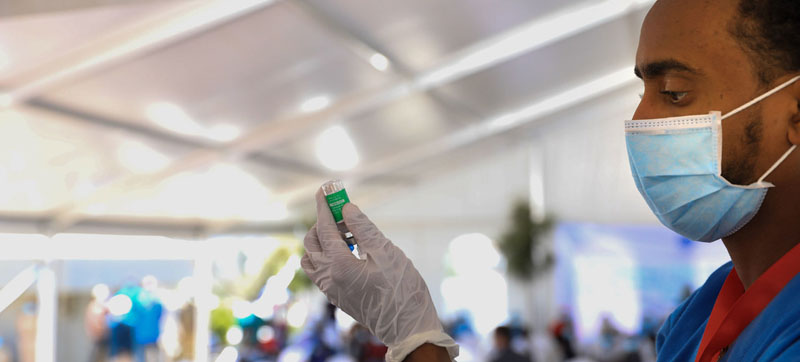
 WHO Vaccine
Equitable distribution of vaccines, equipment only way out of pandemic: WHO chief
New York: Equitable distribution of equipment and medicines to fight COVID-19 is the only way out of the global crisis, the head of the World Health Organization (WHO) said on Tuesday, in remarks to a meeting of the advisory group making the case for investing in these tools.
Briefing the ACT Accelerator Facilitation Council, WHO Director-General Tedros Adhanom Ghebreyesus stated that although countries have made progress in controlling the pandemic, it remains in a very dangerous phase.
“Our only way out is to support countries in the equitable distribution of PPE (personal protective equipment), tests, treatments and vaccines. It is not rocket science, nor charity. It is smart public health and in everyone’s best interest,” he said.
‘Two-track pandemic’
The Council, co-chaired by Norway and South Africa, provides guidance and advice to facilitate the work of the Access to COVID-19 Tools (ACT) Accelerator, launched last April to fight the new disease.
For Tedros, the meeting was as an opportunity to discuss ways to address urgent needs and scale-up lifesaving treatments amid what he described as “a two-track pandemic”.
Countries that are now able to open up, “are those that have largely controlled the supply of lifesaving of personal protective equipment, tests, oxygen, and especially vaccines”, he said.
“Meanwhile, countries without access to sufficient supplies are facing waves of hospitalisations and death. This is being compounded by virus variants.”
The UN’s top health official pointed to signs of hope, as countries are beginning to share vaccines through the global solidarity initiative, COVAX, though he underscored the need for more action.
Currently, more than 180 nations and economies are taking part in the scheme, which aims to ensure everyone, everywhere has access to shots.
Accelerate technology transfer
Tedros added that the financing mechanism supporting COVAX, known as the Advanced Market Commitment, is fully funded for this year “but there are still substantial risks in the vaccine supply forecast.”
WHO together with the International Monetary Fund (IMF), the World Bank and the World Trade Organization (WTO) are working to find practical ways to track, coordinate and advance deliveries to low and middle-income countries.
Last month, the UN agency announced it was supporting the establishment in South Africa of the first technology transfer hub for mRNA vaccines, where manufacturers from developing countries will be trained in how to produce these new treatments.
Messenger RNA, or mRNA technology, instructs cells to make a protein that generates an immune response in the body, thus producing the antibodies that provide protection against a disease. It is the basis for some of the COVID-19 vaccines being used by governments worldwide and by.
Tedros said the announcement of the hub is a positive step forward, “but we need manufacturers to help by sharing know-how and accelerating technology transfer.”
Support Our Journalism
We cannot do without you.. your contribution supports unbiased journalism
IBNS is not driven by any ism- not wokeism, not racism, not skewed secularism, not hyper right-wing or left liberal ideals, nor by any hardline religious beliefs or hyper nationalism. We want to serve you good old objective news, as they are. We do not judge or preach. We let people decide for themselves. We only try to present factual and well-sourced news.
Support objective journalism for a small contribution.


