


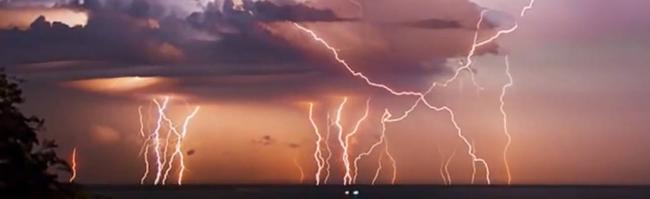
Earth's new lightning capital revealed
Lake Maracaibo in Venezuela earned the top spot receiving an average rate of about 233 flashes per square kilometer per year, according to the study. Researchers had previously identified Africa's Congo Basin as the location of maximum lightning activity.
The research team constructed a very high resolution data set derived from 16 years of space-based LIS observations to identify and rank lightning hotspots. They described their research in theBulletin of the American Meteorological Society.
"We can now observe lightning flash rate density in very fine detail on a global scale," said Richard Blakeslee, LIS project scientist at NASA's Marshall Space Flight Center. "Better understanding of lightning activity around the world enables policy makers, government agencies and other stakeholders to make more informed decisions related to weather and climate."
Blakeslee joined forces with lightning researchers at the University of São Paulo, the University of Maryland, the National Oceanic Atmospheric Administration and the University of Alabama in Huntsville to understand where and when most lightning occurs. Their findings will help forecasters and researchers better understand lightning and its connections to weather and other phenomena.
“Lake Maracaibo has a unique geography and climatology that is ideal for the development of thunderstorms," said Dennis Buechler with the University of Alabama in Huntsville.
Buechler noted that Lake Maracaibo is not new to lightning researchers. Located in northwest Venezuela along part of the Andes Mountains, it is the largest lake in South America. Storms commonly form there at night as mountain breezes develop and converge over the warm, moist air over the lake. These unique conditions contribute to the development of persistent deep convection resulting in an average of 297 nocturnal thunderstorms per year, peaking in September.
Africa remains the continent with the most lightning hotspots, according to the study, home to six of the world's top ten sites for lightning activity. The majority of the hotspots were by Lake Victoria and other lakes along the East African Rift Valley, which have a similar geography to Lake Maracaibo.
The study also confirmed earlier findings that concentrated lightning activity tends to happen over land and reduced lightning activity over oceans and that continental lightning peaks generally in the afternoon.
"Our research using LIS observations in new ways is a prime example of how NASA partners with scientists all over the world to better understand and appreciate our home planet," said Blakeslee.
Developed at Marshall, LIS detects the distribution and variability of total lightning – cloud-to-cloud, intracloud, and cloud to ground – that occurs in the tropical regions of the globe. LIS uses a specialized, high-speed imaging system to look for changes in the optical output caused by lightning in the tops of clouds. By analyzing a narrow wavelength band around 777 nanometers -- which is in the near-infrared region of the spectrum – the sensors can spot brief lightning flashes even under bright daytime conditions that swamp out the small lightning signal.
The team at Marshall that created LIS in the mid-1990s built a spare -- and now that second unit is stepping up to contribute, as well. The sensor is scheduled to launch on a Space Exploration Technologies rocket to the International Space Station in August 2016.
Image: NASA
Support Our Journalism
We cannot do without you.. your contribution supports unbiased journalism
IBNS is not driven by any ism- not wokeism, not racism, not skewed secularism, not hyper right-wing or left liberal ideals, nor by any hardline religious beliefs or hyper nationalism. We want to serve you good old objective news, as they are. We do not judge or preach. We let people decide for themselves. We only try to present factual and well-sourced news.
Support objective journalism for a small contribution.


