


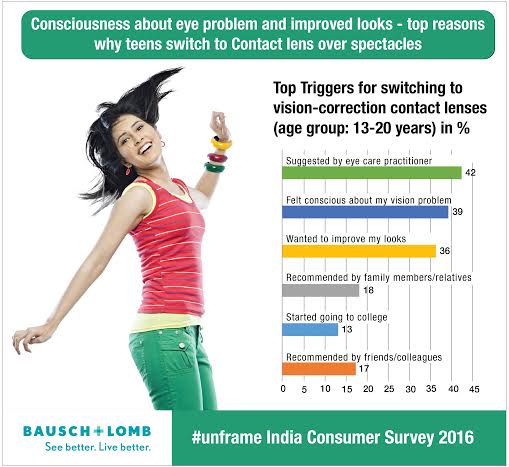
Contact lenses help fit into social circle, feel 60% Indian youth:Survey
The top motivations to use contact lenses, stated by the respondents include – the need to stand out from the crowd (62%), taking charge of life (53%) and achieving a fashionable look (51%), indicating a strong link between contact lenses and self-confidence.
Even as ‘Recommendation from the eye practitioner (physical factor) turned out to be the biggest trigger (at 42%) for the youth, social factors emerged as a close number two trigger for adoption of contact lenses with as many as 39% citing that they felt conscious about their vision problem and 36% quoting that they wanted to transform their look by switching to lenses.
“I purchased and started using contact lenses for going to parties and hanging out with my friends, because however trendy your spectacles are, they still don’t make you look natural. After using lenses for a while, I realized that spectacles tend to leave marks on your nose and face, which is not the case with contact lenses,” said 18-year old female from Jaipur.
The research highlights that majority of youngsters started using contact lenses for the first time during key life events like moving from school to college, first job interview and beginning of work life. Half of them adopted lenses under the influence of their friends and colleagues.
The study further reveals that most males between the age 21-30 years feel they needed contact lenses at their workplace to be perceived as well-groomed. While most females in the same age group consider wearing contact lenses at the prospect of getting married, in order to retain their natural look on the special day.
According to 47% of people from this age group, contact lenses help them project a high class image at workplace and while hanging out with friends and family.
“As a market leader in the contact lens category, with over 60 percent of the market share, we are committed to provide best-in-class and innovative solutions to our customers at affordable prices. The research has helped us gain in-depth understanding of the behaviour and attitude of young Indian consumers towards contact lenses. The study highlights an interesting change in consumer perception of contact lenses being a vision correction solution to more of a lifestyle decision. The findings will help us create new and exciting offerings to fulfill individual consumer needs,” said Sanjay Bhutani, Managing Director, India & SAARC at Bausch + Lomb India.
The research was conducted amongst 2000 respondents from Delhi, Jaipur, Gorakhpur, Bangalore, Madurai, Warangal, Kolkata, Patna, Guwahati, Mumbai, Indore and Kolhapur. The sample included males and females aged between 13-50 years, hailing from SEC A and B. The research uses both qualitative and quantitative methods to derive the findings.
Support Our Journalism
We cannot do without you.. your contribution supports unbiased journalism
IBNS is not driven by any ism- not wokeism, not racism, not skewed secularism, not hyper right-wing or left liberal ideals, nor by any hardline religious beliefs or hyper nationalism. We want to serve you good old objective news, as they are. We do not judge or preach. We let people decide for themselves. We only try to present factual and well-sourced news.
Support objective journalism for a small contribution.


