


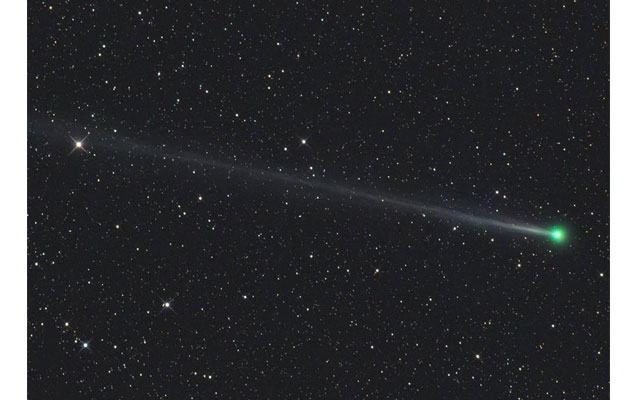
Comet’s trip past Earth offers first in a trio of opportunities
Comet 45P will come closest to Earth on the morning of Saturday, Feb. 11, when it passes by at a distance of about 7.7 million miles (12.4 million kilometers), or more than roughly 30 times the distance between Earth and the moon. It is currently in the early morning eastern sky, though the full moon may make the comet more difficult to spot. The recommendation for backyard astronomers is to use binoculars or a telescope to look for the comet several times during the coming days.
Discovered in 1948, 45P is a short-period comet, with an orbit that takes it around the sun and out by Jupiter about every 5-1/4 years. This weekend’s encounter will be the comet’s closest with Earth through the end of this century. The comet will pass by our planet again in 2032 but will be much farther away – at a distance of nearly 30 million miles (about 48 million kilometers).
Scientists have taken advantage of 45P’s approach, making observations using powerful ground-based telescopes such as NASA’s Infrared Telescope Facility to investigate the gases, dust and ice particles that are released from the comet nucleus and show up in the coma and tail. By looking for water, methane and other important compounds, astronomers get clues about how the comet is put together and where it originated in the cloud of material that surrounded the young sun as the solar system formed.
By observing the same comet more than once, astronomers can see how the object changes over time.
“Observing a comet multiple times over successive orbits is like taking snapshots at different stages of life,” said Joseph Nuth, a senior scientist at NASA’s Goddard Space Flight Center in Greenbelt, Maryland. “And some comets have harder lives than others, depending on how close they get to the sun. We can learn about these effects by comparing different comets with varying perihelion distances over time.”
Ground-based observations also are planned for comet 41P/Tuttle-Giacobini-Kresak, which will pass closest to Earth on April 1, 2017, and for comet 46P/Wirtanen, passing closest to Earth on Dec. 16, 2018. By studying this trio of comets, astronomers can learn more about the differences among comets – information they use to fill in the comet family tree.
“Comet 46P in particular will remain within 10 million miles of Earth for several weeks, from December 4 through 28, 2018,” said Goddard researcher Michael DiSanti. “This will permit detailed studies of its material, as successive regions of the comet’s nucleus become exposed to sunlight.”
Image Credits: Gerald Rhemann
Support Our Journalism
We cannot do without you.. your contribution supports unbiased journalism
IBNS is not driven by any ism- not wokeism, not racism, not skewed secularism, not hyper right-wing or left liberal ideals, nor by any hardline religious beliefs or hyper nationalism. We want to serve you good old objective news, as they are. We do not judge or preach. We let people decide for themselves. We only try to present factual and well-sourced news.
Support objective journalism for a small contribution.


