


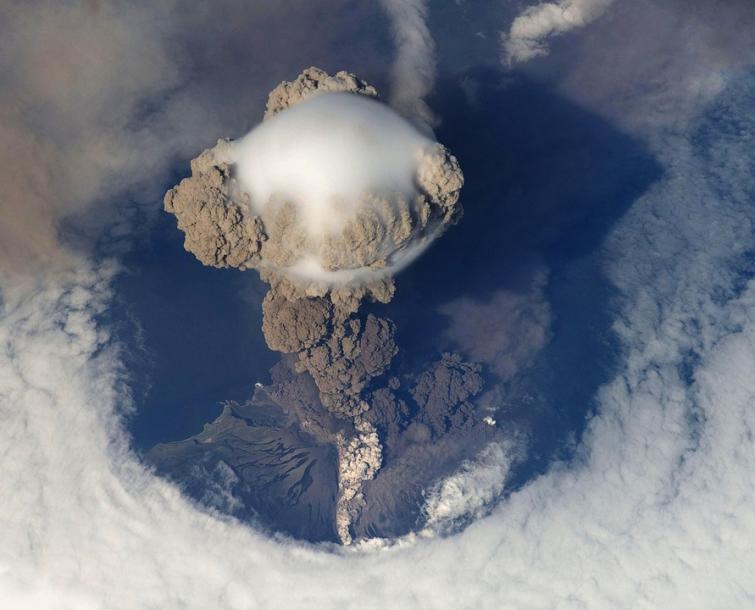
Carbon emissions from volcanic rocks can create global warming - study
London/IBNS: Greenhouse gas emissions released directly from the movement of volcanic rocks are capable of creating massive global warming effects – a discovery which could transform the way scientists predict climate change, a new study reveals.
Scientists’ calculations based on how carbon-based greenhouse gas levels link to movements of magma just below earth’s surface suggest that such geological change has caused the largest temporary global warming of the past 65 million years.
Large Igneous Provinces (LIPs) are extremely large accumulations of igneous rocks which occur when magma travels through the crust towards the surface.
Geologists at the University of Birmingham have created the ï¬rst mechanistic model of carbon emissions changes during the Paleocene-Eocene Thermal Maximum (PETM) - a short interval of maximum temperature lasting around 100,000 years some 55 million years ago.
They published their findings in Nature Communications, after calculating carbon-based greenhouse gas fluxes associated with the North Atlantic Igneous Province (NAIP) – one of Earth's largest LIPs that spans Britain, Ireland, Norway and Greenland.
Dr Stephen Jones, Senior Lecturer in Earth Systems at the University of Birmingham, commented: “Large Igneous Provinces are linked to spikes of change in global climate, ecosystems and the carbon cycle throughout Mesozoic time – coinciding with the Earth’s most devastating mass extinctions and oceans becoming strongly depleted of oxygen.
“We calculated carbon-based greenhouse gas fluxes associated with the NAIP - linking measurements of the process that generated magma with observations of the individual geological structures that controlled gas emissions. These calculations suggest the NAIP caused the largest transient global warming of the past 65 million years.
“More geological measurements are required to reduce the uncertainty range of our solid Earth emissions model, but we believe clariï¬cation of this carbon cycle behaviour will impact modelling and management of future climate change.”
The researchers’ simulations predict peak emissions flux of 0.2–0.5 PgC yr–1 and show that the NAIP could have initiated PETM climate change. Their work is the first predictive model of carbon emissions flux from any proposed PETM carbon source directly constrained by observations of the geological structures that controlled the emissions.
Associations between LIPs and changes in global climate, ecosystems and the carbon cycle during the Mesozoic period imply that greenhouse gases released directly by LIPs can initiate global change that persists over 10,000 to 100,000 years.
The PETM is the largest natural climate change event of Cenozoic time and an important yardstick for theories explaining today's long-term increase in the average temperature of Earth's atmosphere as an effect of human industry and agriculture.
During PETM initiation, release of 0.3–1.1 PgC yr–1 of carbon as greenhouse gases to the ocean-atmosphere system drove 4–5°C of global warming over less than 20,000 years - a relatively short period of time.
Support Our Journalism
We cannot do without you.. your contribution supports unbiased journalism
IBNS is not driven by any ism- not wokeism, not racism, not skewed secularism, not hyper right-wing or left liberal ideals, nor by any hardline religious beliefs or hyper nationalism. We want to serve you good old objective news, as they are. We do not judge or preach. We let people decide for themselves. We only try to present factual and well-sourced news.
Support objective journalism for a small contribution.


