


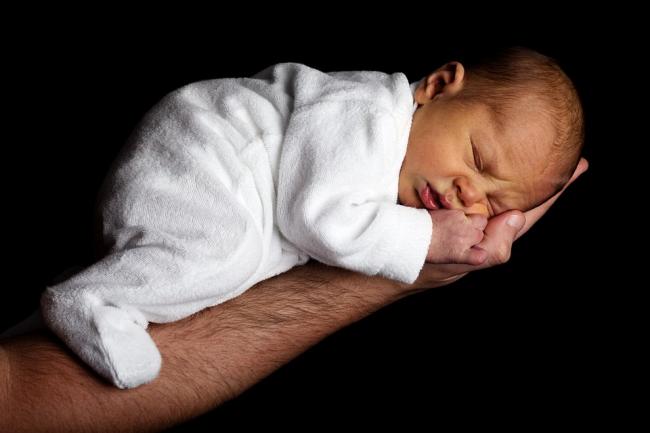
Babies kicking in the womb are creating a map of their bodies: Study
London, Dec 10 (IBNS): The kicks a mother feels from her unborn child may allow the baby to ‘map’ their own body and enable them to eventually explore their surroundings, suggests new research led by UCL in collaboration with UCLH.
For the study, published today in Scientific Reports, researchers measured brainwaves produced when newborn babies kick their limbs during rapid eye movement (REM) sleep, finding that fast brainwaves – a brainwave pattern typically seen in neonates - fire in the corresponding hemisphere.
For example, the movement of a baby’s right hand causes brainwaves to fire immediately afterwards in the part of the left brain hemisphere that processes touch for the right hand. The size of these brainwaves is largest in premature babies, who at that age would usually still be in the womb.
The findings suggest that foetal kicks in the late stages of pregnancy – the third trimester – help to grow areas of the brain that deal with sensory input, and are how the baby develops a sense of their own body. The fast brainwaves evoked by the movement disappear by the time babies are a few weeks old.
“Spontaneous movement and consequent feedback from the environment during the early developmental period are known to be necessary for proper brain mapping in animals such as rats. Here we showed that this may be true in humans too,” explained study author Dr Lorenzo Fabrizi (UCL Neuroscience, Physiology & Pharmacology).
Kimberley Whitehead (UCL Neuroscience, Physiology & Pharmacology) said: “We think the findings have implications for providing the optimal hospital environment for infants born early, so that they receive appropriate sensory input. For example, it is already routine for infants to be ‘nested’ in their cots – this allows them to ‘feel’ a surface when their limbs kick, as if they were still inside the womb.
“As the movements we observed occur during sleep, our results support other studies which indicate that sleep should be protected in newborns, for example by minimising the disturbance associated with necessary medical procedures.”
The babies’ brainwaves were measured using electroencephalography (EEG), and were recorded continuously during sleep. Active sleep was identified behaviourally according to cot side observation of rapid eye movements, largely irregular breathing and frequent, isolated limb movements.
A total of 19 newborns aged two days on average took part in the study, and they were between 31 and 42 weeks corrected gestational age when studied. Corrected gestational age takes into account their age if they were still in the womb; a baby born at 35 weeks and being one week old would have a corrected gestational age of 36 weeks.
The research was carried out at UCL Neuroscience, Physiology & Pharmacology and the Elizabeth Garrett Anderson Obstetric Wing at UCLH, and was kindly supported by the Medical Research Council. Ethical approval was obtained from the NHS Research Ethics Committee.
Support Our Journalism
We cannot do without you.. your contribution supports unbiased journalism
IBNS is not driven by any ism- not wokeism, not racism, not skewed secularism, not hyper right-wing or left liberal ideals, nor by any hardline religious beliefs or hyper nationalism. We want to serve you good old objective news, as they are. We do not judge or preach. We let people decide for themselves. We only try to present factual and well-sourced news.
Support objective journalism for a small contribution.


