


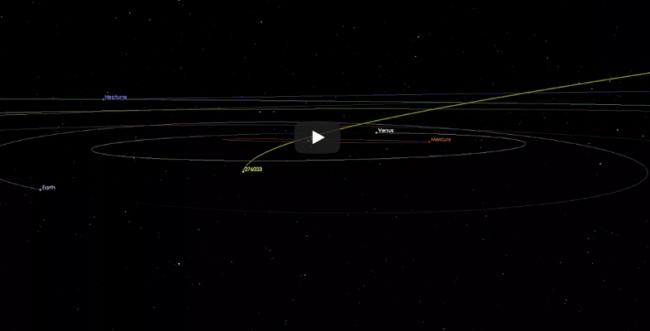
Asteroid 2002 AJ129 to fly safely past Earth on Feb 4
Washington, Jan 22 (IBNS): Asteroid 2002 AJ129 will make a close approach to Earth on Feb. 4, 2018 at 1:30 p.m. PST (4:30 p.m. EST / 21:30 UTC).
At the time of closest approach, the asteroid will be no closer than 10 times the distance between Earth and the Moon (about 2.6 million miles, or 4.2 million kilometers).
2002 AJ129 is an intermediate-sized near-Earth asteroid, somewhere between 0.3 miles (0.5 kilometers) and 0.75 miles (1.2 kilometers) across.
It was discovered on Jan. 15, 2002, by the former NASA-sponsored Near Earth Asteroid Tracking project at the Maui Space Surveillance Site on Haleakala, Hawaii. The asteroid’s velocity at the time of closest approach, 76,000 mph (34 kilometers per second), is higher than the majority of near-Earth objects during an Earth flyby.
The high flyby velocity is a result of the asteroid’s orbit, which approaches very close to the Sun -- 11 million miles (18 million kilometers). Although asteroid 2002 AJ129 is categorized as a Potentially Hazardous Asteroid (PHA), it does not pose an actual threat of colliding with our planet for the foreseeable future.
“We have been tracking this asteroid for over 14 years and know its orbit very accurately,” said Paul Chodas, manager of NASA’s Center for Near-Earth Object Studies at the Jet Propulsion Laboratory, Pasadena, California. “Our calculations indicate that asteroid 2002 AJ129 has no chance — zero — of colliding with Earth on Feb. 4 or any time over the next 100 years.”
JPL hosts the Center for Near-Earth Object Studies for NASA's Near-Earth Object Observations Program, an element of the Planetary Defense Coordination Office within the agency's Science Mission Directorate.
Image: NASA website
Support Our Journalism
We cannot do without you.. your contribution supports unbiased journalism
IBNS is not driven by any ism- not wokeism, not racism, not skewed secularism, not hyper right-wing or left liberal ideals, nor by any hardline religious beliefs or hyper nationalism. We want to serve you good old objective news, as they are. We do not judge or preach. We let people decide for themselves. We only try to present factual and well-sourced news.
Support objective journalism for a small contribution.


