


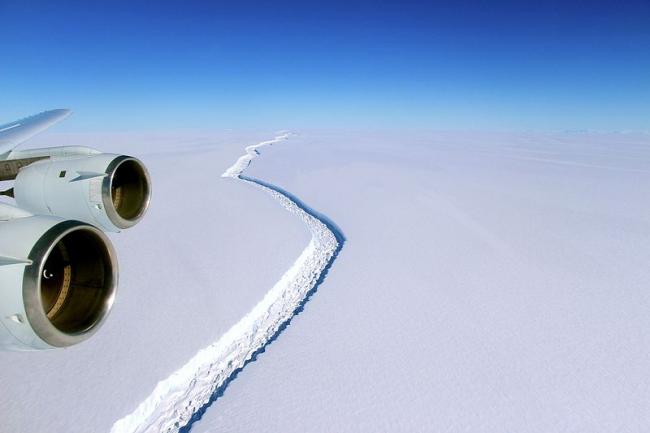
Antarctic study sheds light on central ice sheet
The study of mountains in West Antarctica will help scientists improve their predictions of how the region might respond to continuing climate change, read the Universities of Edinburgh website.
Its findings could also show how ice loss might contribute to sea level rise.
Although the discovery demonstrates the long-term stability of some parts of Antarctica’s ice sheet, scientists remain concerned that ice at its coastline is vulnerable to rising temperatures.
Researchers from the Universities of Edinburgh and Northumbria studied rocks on slopes of the Ellsworth Mountains, whose peaks protrude through the ice sheet.
By mapping and analysing surface rocks – including measuring their exposure to cosmic rays – researchers calculated that the mountains have been shaped by an ice sheet over a million-year period, beginning in a climate some 20C warmer than at present.
The last time such climates existed in the mountains of Antarctica was 14 million years ago when vegetation grew in the mountains and beetles thrived.
Antarctica’s climate at the time would be similar to that of modern day Patagonia or Greenland.
This time marked the start of a period of cooling and the growth of a large ice sheet that extended offshore around the Antarctic continent.
Glaciers have subsequently cut deep into the landscape, leaving a high-tide mark – known as a trimline – in the exposed peaks of the Ellsworth range.
The extended ice sheet cooled the oceans and atmosphere, helping form the world of today, researchers say.
Their study is among the first to find evidence for this period in West Antarctica.
The research, published in Earth and Planetary Science Letters, was done in collaboration with the Scottish Universities Environmental Research Centre.
It was funded by the UK Natural Environment Research Council and supported by British Antarctic Survey.
Image: Wikimedia Commons
Support Our Journalism
We cannot do without you.. your contribution supports unbiased journalism
IBNS is not driven by any ism- not wokeism, not racism, not skewed secularism, not hyper right-wing or left liberal ideals, nor by any hardline religious beliefs or hyper nationalism. We want to serve you good old objective news, as they are. We do not judge or preach. We let people decide for themselves. We only try to present factual and well-sourced news.
Support objective journalism for a small contribution.


