


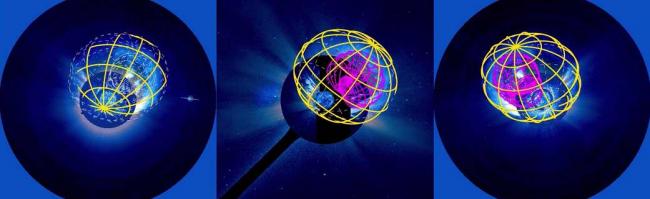
3 NASA satellites recreate solar eruption in 3-D
Washington, Mar 10 (IBNS): The more solar observatories, the merrier: Scientists have developed new models to see how shocks associated with coronal mass ejections, or CMEs, propagate from the Sun — an effort made possible only by combining data from three NASA satellites to produce a much more robust mapping of a CME than any one could do alone.
Much the way ships form bow waves as they move through water, CMEs set off interplanetary shocks when they erupt from the Sun at extreme speeds, propelling a wave of high-energy particles. These particles can spark space weather events around Earth, endangering spacecraft and astronauts.
Understanding a shock’s structure — particularly how it develops and accelerates — is key to predicting how it might disrupt near-Earth space.
But without a vast array of sensors scattered through space, these things are impossible to measure directly. Instead, scientists rely upon models that use satellite observations of the CME to simulate the ensuing shock’s behavior.
The scientists — Ryun-Young Kwon, a solar physicist at George Mason University in Fairfax, Virginia, and Johns Hopkins University Applied Physics Laboratory, or APL, in Laurel, Maryland, and APL astrophysicist Angelos Vourlidas — pulled observations of two different eruptions from three spacecraft: ESA/NASA’s Solar and Heliospheric Observatory, or SOHO, and NASA’s twin Solar Terrestrial Relations Observatory, or STEREO, satellites. One CME erupted in March 2011 and the second, in February 2014.
The scientists fit the CME data to their models — one called the “croissant” model for the shape of nascent shocks, and the other the “ellipsoid” model for the shape of expanding shocks — to uncover the 3-D structure and trajectory of each CME and shock.
Each spacecraft’s observations alone weren’t sufficient to model the shocks. But with three sets of eyes on the eruption, each of them spaced nearly evenly around the Sun, the scientists could use their models to recreate a 3-D view.
Their work confirmed long-held theoretical predictions of a strong shock near the CME nose and a weaker shock at the sides.
In time, shocks travel away from the Sun, and thanks to the 3-D information, the scientists could reconstruct their journey through space.
The modeling helps scientists deduce important pieces of information for space weather forecasting — in this case, for the first time, the density of the plasma around the shock, in addition to the speed and strength of the energized particles.
All of these factors are key to assessing the danger CMEs present to astronauts and spacecraft. Their results are summarized in a paper published in the Journal of Space Weather and Space Climate published on Feb. 13, 2018.
Image: NASA
Support Our Journalism
We cannot do without you.. your contribution supports unbiased journalism
IBNS is not driven by any ism- not wokeism, not racism, not skewed secularism, not hyper right-wing or left liberal ideals, nor by any hardline religious beliefs or hyper nationalism. We want to serve you good old objective news, as they are. We do not judge or preach. We let people decide for themselves. We only try to present factual and well-sourced news.
Support objective journalism for a small contribution.


